

Choosing the most established network for your capital might actually be the fastest way to erode your trading margins. You’ve likely felt the frustration of high gas fees during a volatile market swing or waited for a confirmation while a prime gold price entry slipped away. It’s a common struggle for traders who need agility but find themselves tethered to congested infrastructure. Understanding the nuances of USDT TRC20 vs ERC20 is no longer just a technical requirement; it’s a strategic necessity for anyone serious about maximizing capital efficiency.
This comparison provides the clarity you need to optimize your transaction overhead and ensure absolute security for high-value transfers. You’ll learn how to leverage the Tron network’s low fees for rapid moves or utilize Ethereum’s deep liquidity for institutional-grade stability. We examine the 2026 landscape of settlement speeds and security audits to help you integrate these networks into a transformative trading strategy that can redefine your financial future. This guide prepares you to navigate Forex and XAU/USD CFD markets with the precision and confidence of a global industry leader.
Key Takeaways
- Identify the optimal balance between Ethereum’s institutional liquidity and Tron’s cost-efficiency by mastering the technical nuances of USDT TRC20 vs ERC20.
- Reduce operational friction and preserve your trading margin by utilizing TRC20’s sub-minute confirmation speeds for high-frequency Gold and Forex CFD positions.
- Ensure absolute security for large-scale capital movements by leveraging ERC20’s deep ecosystem compatibility and Tether’s verified 2026 reserve transparency.
- Transform your financial agility in the XAU/USD and currency markets by strategically selecting network rails that minimize transaction overhead.
- Streamline your trading lifecycle with Pallapay’s regulated infrastructure, bridging the gap between digital liquidity and institutional-grade financial utility.
What is USDT? Understanding the Multi-Chain Stablecoin
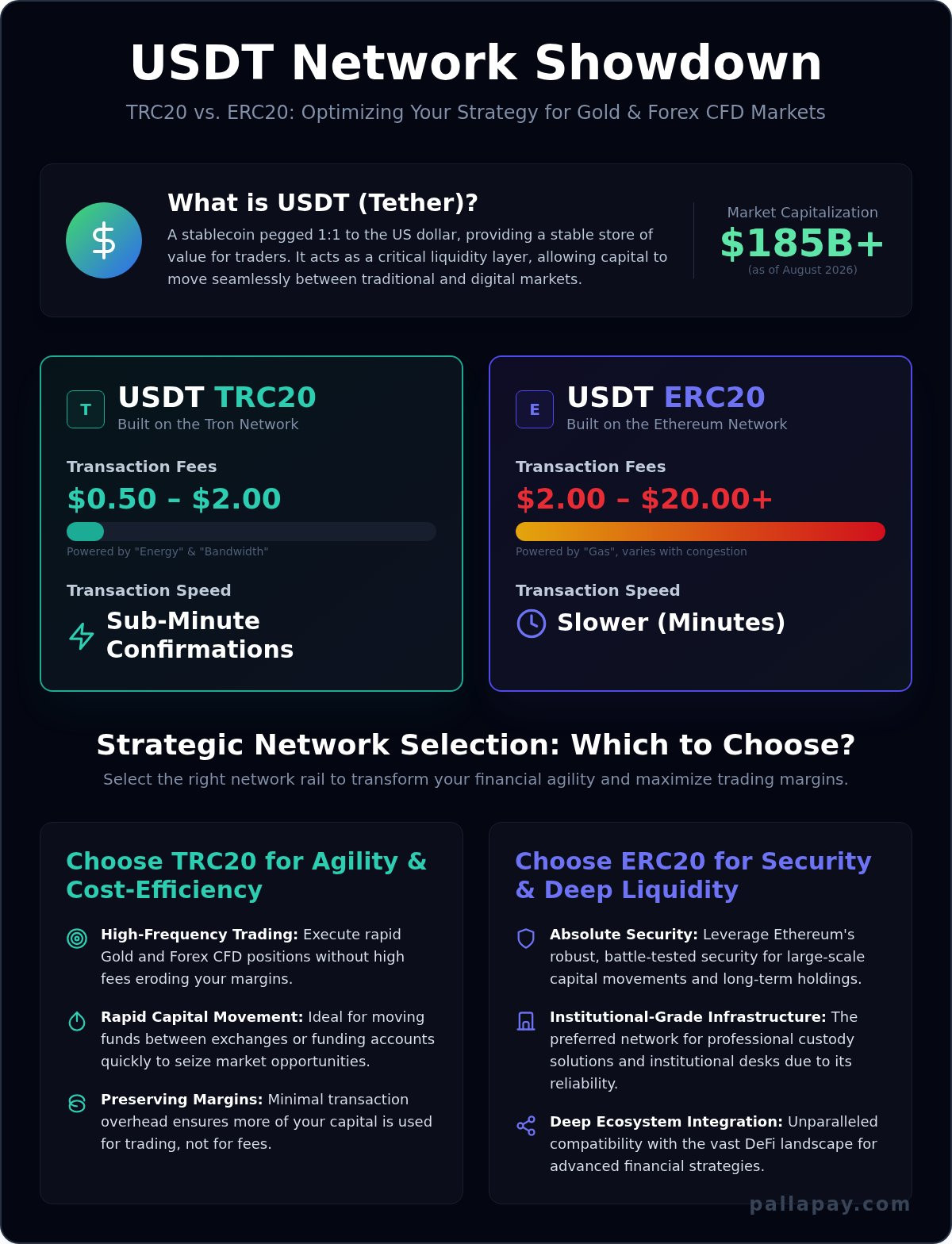
USDT is the foundational asset of the modern digital economy. It functions as a Tether stablecoin, maintaining a 1:1 peg with the US dollar to provide a reliable store of value amidst market volatility. For traders engaging in high-stakes environments like Gold and Forex CFD trading, this stability is essential. USDT acts as a cross-chain liquidity layer for global finance, allowing capital to move between traditional markets and digital ecosystems without the friction of constant fiat conversion. As of August 2026, Tether’s market capitalization has reached approximately $185 billion, solidifying its position as a primary settlement instrument for professional investors.
The distinction between versions of the asset lies in the underlying blockchain protocol, often called the “rail.” When discussing USDT TRC20 vs ERC20, we’re comparing the technical infrastructure used to settle transactions. While the value of the token remains constant, the choice of network determines your operational speed, cost, and security profile. This decision can be the difference between a profitable trade and a missed opportunity when price action accelerates in the currency markets. The choice typically falls between two dominant standards:
- ERC20: The Ethereum-based protocol known for its institutional-grade security and deep ecosystem integration.
- TRC20: The Tron-based protocol optimized for rapid settlement and minimal transaction overhead.
The Role of ERC20 in the Ethereum Ecosystem
Launched in 2017, the ERC20 standard was the first major protocol to host USDT. It leverages Ethereum’s massive decentralized finance infrastructure, offering unparalleled depth and security. It’s often considered the gold standard for institutional players and large-scale holdings. If you’re managing significant capital for long-term USD CFD positions, the ERC20 network provides a level of trust and integration that’s difficult to match. Its security architecture ensures that high-value transfers are handled with the robustness required by professional financial standards. Many institutional desks prefer this rail because of its deep integration with professional custody solutions and its long history of reliability.
The Rise of TRC20 for High-Frequency Transfers
The TRC20 standard emerged as a direct response to Ethereum’s scalability challenges. Built on the Tron blockchain, it prioritizes speed and minimal overhead. For active participants in the Forex market, every second counts. TRC20 allows for sub-minute confirmations, making it the preferred choice for high-frequency transfers and exchange deposits. It’s become the dominant rail for retail commerce and P2P payments because it eliminates the prohibitive costs often associated with network congestion. By choosing the TRC20 rail, traders can move their USDT with the agility needed to capitalize on sudden shifts in XAU/USD pricing. This efficiency ensures that transaction fees don’t eat into margins, transforming how individuals manage their financial lives through strategic market participation.
USDT TRC20 vs ERC20: Key Technical Differences
The operational efficiency of a global trader often hinges on the underlying mechanics of their chosen settlement layer. When comparing USDT TRC20 vs ERC20, the primary technical divergence lies in the consensus mechanisms and resource allocation of their respective blockchains. Ethereum utilizes a Proof of Stake model that prioritizes decentralization, while Tron employs Delegated Proof of Stake to facilitate higher transaction volumes. For those managing high-value XAU/USD CFD positions, these technicalities dictate the speed at which margin can be deployed and the cost of maintaining liquidity. Strategic selection of these rails can fundamentally alter a trader’s financial trajectory by preserving capital for market opportunities rather than losing it to network overhead.
Transaction fees in 2026 reflect this architectural split. ERC20 transfers rely on “Gas,” which fluctuates based on Ethereum network congestion. Research indicates these costs typically range from $2 to over $20 for a single transaction. In contrast, the TRC20 network utilizes a system of “Energy” and “Bandwidth,” keeping costs predictably low, generally between $0.50 and $2. While Ethereum offers the most robust security profile for institutional capital, Tron’s sub-minute confirmation speeds provide the agility required for rapid Forex market entries. Professional traders must weigh the absolute security of Ethereum against the near-instant finality of Tron to optimize their trading outcomes and ensure their capital is always where the growth is.
Address Formats: How to Identify Your Network
Identifying the correct network is the first step in safeguarding your capital against permanent loss. ERC20 addresses are hexadecimal and always begin with “0x,” appearing as 0x71C… and similar strings. TRC20 addresses are alphanumeric and always start with a capital “T,” such as TXnL… . Sending TRC20 tokens to an ERC20 address, or vice versa, typically results in a total loss of funds because these networks aren’t natively interoperable. Using a secure multichain wallet is essential to ensure you’re interacting with the correct protocol before confirming any transfer. This simple visual check is a critical component of institutional-grade security for individual traders.
Fee Structures and Gas Costs in 2026
The 2026 landscape has seen TRC20 become the dominant rail for micro-transactions and retail-level trading. Its low overhead allows traders to move smaller amounts of capital without fees consuming their potential profit. While Ethereum’s Layer 2 solutions have improved scalability, the base layer ERC20 remains the preferred choice for large-scale institutional transfers where deep liquidity is paramount. As U.S. stablecoin regulation continues to evolve, the transparency and auditability of these networks provide a secure foundation for transformative financial growth. Choosing the right rail isn’t just about saving money; it’s about aligning your technical infrastructure with your long-term wealth creation goals in the USD CFD and commodity markets.
Strategic Network Selection: Which Should You Choose?
Liquidity remains a primary consideration for global traders. Before initiating a transfer, you must verify the preferences of your counterparties. While the Tron network handles the majority of retail transaction volume in 2026, many institutional liquidity providers still prioritize the Ethereum ecosystem for its unparalleled decentralization. Choosing the wrong rail can result in significant delays or the total loss of funds. Professional traders often maintain a diversified presence across both networks to ensure they can capitalize on opportunities in the USD CFD markets regardless of which infrastructure a specific broker or exchange requires. This agility is what separates successful market participants from those who are sidelined by technical friction.
Managing Institutional Liquidity
High-net-worth individuals and institutional desks often default to ERC20 for its established reputation and broad integration with professional custody solutions. Managing these multi-chain assets requires a partner that understands the complexities of global liquidity. Utilizing Pallapay’s OTC exchange allows traders to handle high-volume transfers with the precision required for transformative financial growth. While Ethereum provides a robust framework, staying informed about stablecoin security risks is essential for anyone managing significant capital. A multi-network approach provides the operational flexibility needed to navigate volatile market shifts without being hindered by a single point of technical failure.
Avoiding Common Transfer Pitfalls
The most sophisticated trading strategy can be derailed by a simple administrative error. Implementing a ‘test transaction’ strategy by sending a single USDT before moving larger sums is a vital safeguard that can save thousands in lost capital. It’s also critical to verify network support on both the sending and receiving ends before clicking confirm. Using secure crypto wallets that provide clear network identification helps prevent cross-network errors that lead to irreversible fund loss. These small, disciplined steps ensure that your focus remains on the transformative potential of the Gold and Forex markets rather than on rectifying avoidable technical mistakes. Consistency in these procedures builds the foundation for long-term financial stability.
Beyond the Transfer: Fueling Transformative Gold and Forex CFD Trading
USDT is more than a stable digital asset; it serves as the primary engine for accessing global liquidity in the XAU/USD and currency markets. Mastering the choice between USDT TRC20 vs ERC20 allows traders to move capital with institutional precision, directly impacting available margin and trading agility. In the fast-moving 2026 market environment, where Gold and USD pairs remain the most strategic assets for wealth preservation, the speed of funding a position often determines the final outcome. Efficient network transfers ensure that capital is never idle when market volatility creates a high-conviction entry point.
The transformative potential of professional trading lies in its ability to change an individual’s financial life through disciplined market access. By utilizing USDT as a bridge, you bypass the traditional banking friction that often stalls global capital flows. This digital-first approach provides the flexibility to pivot between asset classes with ease. Whether you are hedging against inflation with Gold or capitalizing on currency fluctuations, the technical rail you choose for your USDT is the foundation of your operational success. It’s a strategic tool designed to fuel long-term financial growth.
The Power of CFD Trading with USDT
Traditional banking systems frequently introduce delays that are incompatible with the real-time nature of Forex markets. Leveraging USDT allows you to bypass this friction, providing immediate exposure to price movements through CFD trading without the need for complex remittance procedures. The TRC20 network is particularly effective for this purpose. Its sub-minute confirmation times allow for rapid capital deployment when Gold (XAU) prices shift unexpectedly. Using USDT as your base currency ensures that your trading account remains liquid, allowing you to capture gains from USD pairs with the speed required by modern financial standards. This efficiency is essential for maintaining a competitive edge in high-leverage environments.
Achieving Financial Evolution Through Professional Trading
Moving from passive holding to active, strategic wealth generation is a significant step in any financial evolution. High-leverage CFD markets provide the exposure necessary to accelerate this progress, but they require a reliable infrastructure to succeed. A sophisticated partner is required to manage the underlying crypto-to-fiat flows, ensuring that your trading gains are accessible and secure. By integrating professional-grade tools into your strategy, you can focus on the market decisions that drive your financial independence. This level of control over your capital is what enables a truly transformative trading experience. To maximize your efficiency, you can convert crypto to fiat instantly and bridge the gap between digital success and real-world utility.
Seamless USDT Management with Pallapay’s Institutional Ecosystem
Navigating the technical landscape of USDT TRC20 vs ERC20 requires a strategic partner that bridges the gap between digital innovation and institutional reliability. Pallapay serves as this essential facilitator, providing a regulated environment for traders to manage their stablecoin liquidity with absolute confidence. With MSB registrations in the United States and Canada, the platform ensures that every transaction meets rigorous compliance standards. This institutional-grade framework allows you to focus on the transformative potential of the markets while the underlying technical complexities are handled with professional precision. Whether you’re moving capital between global exchanges or securing profits from a successful gold trade, the integrated ecosystem provides the stability you need to grow.
Efficiency is the cornerstone of modern trading. When you need to move from digital success to real-world utility, Pallapay’s off-ramp provides the technological answer to immediate liquidity needs. It enables traders to convert their USDT holdings into fiat instantly, ensuring that capital is always accessible for both reinvestment and personal requirements. This seamless transition is vital for those participating in the fast-paced USD CFD markets, where the ability to realize gains quickly can define a trader’s financial trajectory. By eliminating the friction typically found in traditional banking channels, you gain a competitive edge in capital management.
High-Volume OTC and Cash Exchange
Institutional traders and high-net-worth individuals require more than just a standard retail interface; they need deep liquidity and professional-grade spreads. Pallapay’s OTC desks facilitate the ability to buy and sell USDT for cash instantly, supporting volumes that standard exchanges often struggle to process. This service is particularly beneficial for those managing large-scale Forex positions where slippage can significantly impact margins. Additionally, the integration of fiat settlement services empowers businesses to scale their operations by bridging the gap between crypto-assets and traditional financial systems. It’s a comprehensive solution designed for the demands of 2026 global commerce.
The Pallapay Mastercard: Real-World Utility
Transforming trading profits into daily lifestyle utility is the final step in achieving financial evolution. The Pallapay Mastercard allows you to spend your USDT, whether held as TRC20 or ERC20, directly in the global economy. This integration removes the final barrier between your digital portfolio and your real-world expenses, providing a secure and effortless way to utilize your market gains. For those seeking to use their digital liquidity for international services, you can learn more about پینگول to explore options for global gift cards. It represents a sophisticated tool for the modern financial pioneer, ensuring that your success in Gold and Forex CFD trading translates into tangible personal growth. By centralizing your financial life within one secure ecosystem, you accelerate your progress toward long-term independence.
Mastering the Future of Global Settlement
The strategic distinction between USDT TRC20 vs ERC20 represents more than a technical preference; it’s a decision that defines your agility in the global markets. By aligning your network selection with your operational needs, you ensure that high-value transfers remain secure while maintaining the speed required for XAU/USD and currency trading. Success in the 2026 landscape depends on a sophisticated infrastructure that preserves your margin and facilitates immediate capital deployment. It’s the foundation of a truly transformative financial journey.
Pallapay serves as the professional bridge for this evolution, offering institutional-grade OTC desks and secure operations as a regulated MSB in the US and Canada. With a presence serving over 180 countries, the ecosystem provides the stability and global reach necessary for modern traders. You can now move between digital liquidity and real-world utility with the confidence of an industry leader. Start your financial transformation with Pallapay’s secure USDT off-ramp and unlock the full potential of your trading strategy today.
Frequently Asked Questions
How do I know if my USDT is ERC20 or TRC20?
You can identify the network by examining the receiving address format. ERC20 addresses always begin with “0x,” while TRC20 addresses start with a capital “T.” Understanding the technical nuances of USDT TRC20 vs ERC20 is essential for maintaining fund safety. Most wallets and exchanges also display the network standard next to your balance. It’s vital to confirm this before initiating any transfer to ensure your capital remains secure.
Can I send USDT from an ERC20 wallet to a TRC20 address?
You cannot send USDT directly between these two networks because they operate on different blockchain protocols. Attempting to send ERC20 tokens to a TRC20 address usually results in a total loss of funds. To move assets between them, you must use a bridge or an exchange that supports both standards. This technical boundary is a critical safety feature that requires constant vigilance from professional market participants.
Which network has the lowest fees for USDT transfers in 2026?
The TRC20 network consistently offers the lowest transaction fees for stablecoin transfers. In 2026, TRC20 fees typically range from $0.50 to $2, whereas ERC20 costs can fluctuate between $2 and $20 depending on Ethereum network congestion. For traders managing active Forex or Gold CFD positions, the lower overhead of TRC20 helps preserve profit margins and allows for more frequent capital adjustments and entries.
Is ERC20 more secure than TRC20 for large crypto transfers?
ERC20 is often preferred for large-scale institutional transfers due to Ethereum’s superior decentralization and security architecture. While TRC20 is faster and more cost-effective for daily retail use, the ERC20 standard provides a more robust framework for long-term storage of significant capital. Professional traders often weigh these factors against the specific liquidity needs of their USD CFD trading strategies to determine the safest fit for their wealth.
How long does it take to confirm a USDT TRC20 transaction?
A USDT TRC20 transaction typically confirms within 3 to 5 seconds, though most exchanges require a few additional confirmations for finality. This usually results in a total processing time of less than one minute. This speed is a primary advantage for market participants who need to move capital quickly to capitalize on sudden price shifts in the XAU/USD or global currency markets without delay.
What happens if I send USDT to the wrong network?
Sending USDT to the wrong network usually results in an irreversible loss of capital. Because the Ethereum and Tron blockchains aren’t natively interoperable, tokens sent to an incompatible address are effectively removed from circulation. You should always perform a small test transaction before moving substantial amounts to ensure both the sending and receiving platforms are aligned on the chosen network standard to prevent permanent errors.
Can I use USDT to trade Forex and Gold CFDs?
You can certainly use USDT to access Gold and Forex CFD markets through modern trading platforms. It serves as an efficient bridge, allowing you to bypass traditional banking friction and deploy capital into high-leverage positions quickly. This access can be transformative for your financial life, providing the agility to trade global price movements in XAU/USD and major currency pairs with institutional precision and speed.
How do I withdraw USDT TRC20 to my bank account?
To withdraw USDT TRC20 to your bank account, you must utilize a regulated off-ramp service. You can send your tokens to a provider like Pallapay, convert the digital assets into fiat currency, and then initiate a bank transfer. This process bridges the gap between your trading profits and real-world utility, ensuring your market success translates into tangible financial growth and stability for your daily lifestyle expenses.
Disclaimer
The information provided on this website and blog is for general informational and educational purposes only and does not constitute financial, investment, legal, tax, or other professional advice.
Cryptocurrency and digital asset services may be subject to regulatory restrictions in certain jurisdictions. Users are solely responsible for ensuring compliance with applicable local laws and regulations before using any products or services mentioned on this website.
PallaPay does not guarantee the accuracy, completeness, or timeliness of any information published and accepts no liability for any loss or damages arising from reliance on the content. Any opinions expressed are those of the respective authors and may change without notice.
Certain services, features, or products referenced may be provided through third-party partners, licensed entities, or affiliated service providers subject to separate terms and regulatory approvals. Availability of services may vary by country or region.
This website may contain references to digital assets, virtual currencies, or blockchain-related services that are not available to residents of certain jurisdictions, including where prohibited by law. Nothing on this website constitutes an offer, solicitation, or recommendation to buy or sell any financial instrument or virtual asset.