

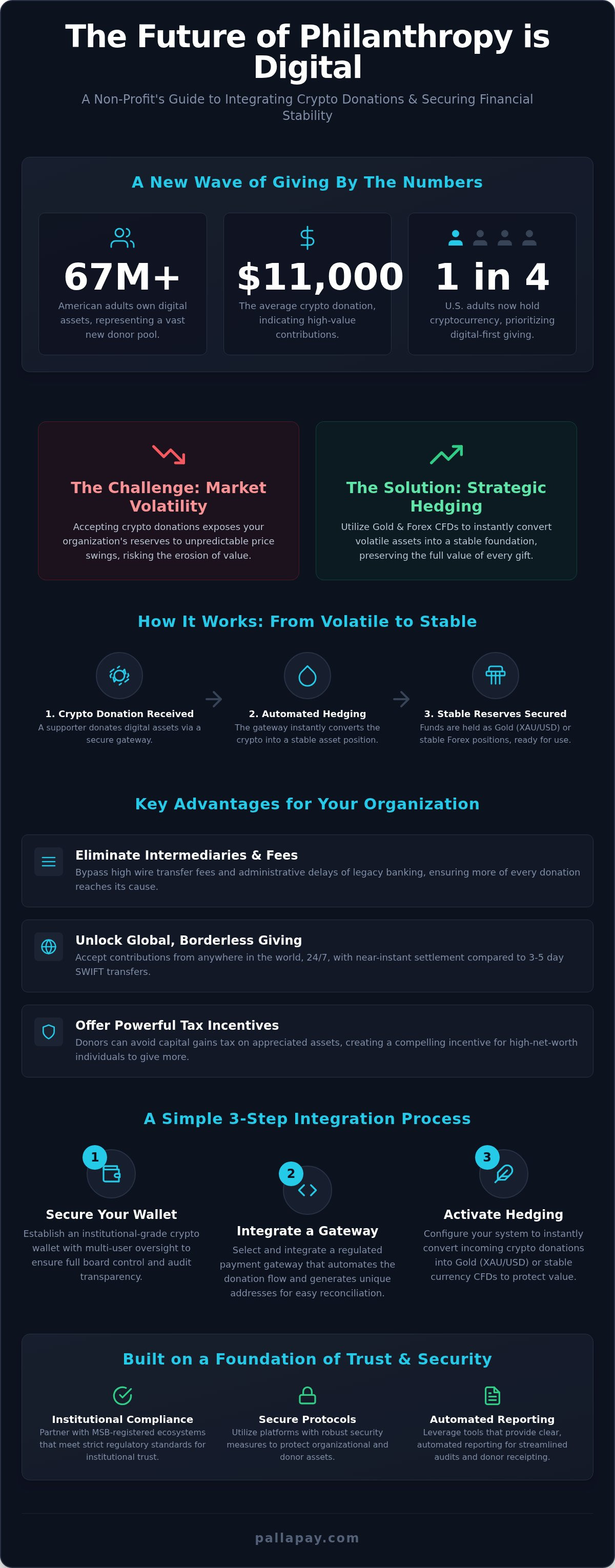
Over 67 million American adults now own digital assets, and the average crypto donation surged past $11,000 in 2025. You likely recognize that the decision to accept crypto donations for non-profit organizations is no longer a niche experiment; it is a vital strategy for institutional growth. However, the fear of market volatility and the complexity of regulatory reporting can make even the most forward-thinking board feel hesitant.
It’s time to bridge the gap between disruptive innovation and financial reliability. This article provides a comprehensive roadmap to integrate cryptocurrency fundraising while maintaining absolute fiscal security. You’ll learn how to transform these digital gifts into a stable foundation by leveraging advanced financial tools like Gold and Forex CFDs. By converting volatile assets into XAU/USD or stable currency positions, your organization can mitigate risk and ensure a steady stream of high-value support. We will explore the mechanics of modern crypto gateways and the strategic impact of CFD trading on your non-profit’s long-term reserves.
Key Takeaways
- Capitalize on the demographic shift by engaging high-net-worth Millennial and Gen Z donors who are increasingly prioritizing digital asset philanthropy.
- Learn the streamlined process to accept crypto donations for non-profit organizations using regulated gateways that provide instant conversion and automated reporting.
- Protect your organization’s reserves from market volatility by utilizing Gold (XAU/USD) and Forex CFDs as sophisticated hedging instruments.
- Ensure institutional compliance and board approval by partnering with MSB-registered ecosystems that offer transparent, secure crypto security protocols.
- Transform digital contributions into immediate operational liquidity through high-speed fiat settlement and integrated financial management tools.
Why Non-Profits are Prioritizing Crypto Philanthropy in 2026
Digital assets have evolved from speculative instruments into a cornerstone of institutional fundraising. By mid-2026, crypto philanthropy has established itself as the fastest-growing revenue stream for modern NGOs, driven by a fundamental shift in global wealth distribution. As one in four American adults now holds cryptocurrency, the decision to accept crypto donations for non-profit organizations is a strategic necessity for reaching an affluent, tech-savvy donor base. Gen Z and Millennial supporters, who represent a significant portion of this 67-million-person demographic, prioritize organizations that offer frictionless, digital-first giving options. They don’t just want to give; they want to give efficiently.
Beyond donor acquisition, blockchain technology addresses the operational inefficiencies of traditional finance. By removing banking intermediaries, your organization eliminates high wire transfer fees and the administrative delays inherent in legacy systems. This ensures that a higher percentage of every gift reaches its intended destination. The 2026 fiscal outlook confirms that digital assets are now a standardized form of “property,” allowing for sophisticated, tax-efficient contributions that benefit both the donor and the recipient.
The Tax Advantages of Digital Asset Donations
The IRS classifies cryptocurrency as property rather than currency, creating a powerful incentive for high-net-worth individuals to contribute. When a donor gives appreciated assets held for over a year, they avoid capital gains tax entirely while claiming a deduction for the fair market value. For donations exceeding $500, non-profits must assist donors with IRS Form 8283. Issuing compliant receipts for digital property is essential for major donor stewardship, ensuring these contributors feel secure in their financial planning. It’s a professional bridge that turns a technical transaction into a lasting philanthropic partnership.
Global Reach and Cross-Border Giving
International NGOs often face significant hurdles with traditional SWIFT transfers, which typically require three to five business days to settle. Cryptocurrency provides a near-instant alternative that functions 24/7 without geographic borders. This speed is mirrored by the transparency of public ledgers, where every transaction is verifiable by board members and auditors alike. History shows the transformative potential of this scale; the Pineapple Fund famously distributed $55 million worth of Bitcoin to various causes, proving that digital assets can sustain massive global operations. For organizations looking to scale, using a fiat settlement system ensures that these global gifts are converted into usable liquidity without the wait.
How to Accept Crypto Donations: A Step-by-Step Integration
Transitioning from traditional fundraising to digital asset acquisition requires a structured technical approach. The process begins with establishing a secure, institutional-grade crypto wallet designed to manage organizational assets with multi-user oversight. This infrastructure ensures that your board maintains full control over private keys while providing the transparency required for annual audits. By setting this foundation, your organization can accept gifts of cryptocurrency with the same professional rigor applied to stock transfers or cash endowments.
Once your custody solution is active, the next step involves selecting a regulated gateway to automate the donation flow. You’ll need to integrate a dedicated donation button or a custom landing page that mirrors your existing brand identity. This interface should facilitate “Know Your Donor” (KYD) compliance by collecting essential data during the transaction. Before going live, it’s vital to perform small-scale test transactions to verify ledger accuracy and ensure that funds are routing correctly to your treasury.
Implementing a Crypto Payment Gateway
While some organizations use static wallet addresses, this method lacks the scalability and security required for high-volume fundraising. Static addresses are public and don’t provide unique identifiers for individual donors, making reconciliation difficult. Utilizing the Pallapay Payment API is a superior alternative because it generates unique payment addresses for every transaction. This automation mitigates the risk of manual errors and allows for real-time conversion. By converting crypto to fiat instantly, your non-profit eliminates the risk of price fluctuations between the moment a gift is sent and the moment it’s processed.
Capturing Donor Information and Stewardship
The perceived anonymity of blockchain can conflict with non-profit reporting requirements. You can solve this by integrating data capture fields directly into the donation flow. Collecting names, emails, and physical addresses ensures you meet IRS reporting thresholds, such as the $5,000 limit for qualified appraisals. Automated “Thank You” emails should trigger immediately after a transaction is confirmed on the ledger, providing the donor with a compliant tax receipt. Using a centralized dashboard to track gift frequency and donor trends allows your development team to identify and steward major gift prospects effectively. If you’re ready to modernize your fundraising, exploring a scalable payment integration is the next logical step.
Finalizing the integration involves a rigorous testing phase. Use testnet environments to simulate various donation scenarios, including high-traffic events. This ensures that your website remains responsive and that the ledger records align perfectly with your internal accounting software. Accuracy at this stage builds the institutional trust necessary for long-term success.
Managing Volatility: Hedging with Gold and Forex CFDs
While many platforms suggest immediate liquidation to fiat, this approach often ignores the potential for institutional wealth growth. To truly accept crypto donations for non-profit organizations in 2026, leadership must move beyond passive asset holding. You can transform your organization’s fiscal future by adopting professional trading mechanics that were once reserved for high-level financial institutions. Contracts for Difference (CFDs) offer a sophisticated method to hedge against market volatility without requiring the physical delivery of assets. This shift from simple conversion to strategic management allows an NGO to protect its purchasing power while maintaining a growth-oriented endowment. It’s a method to ensure that a donation received today doesn’t lose its impact by tomorrow.
The Role of Gold (XAU) in Non-Profit Endowments
Institutional boards often view digital assets as high-risk. You can mitigate this perception by allocating a portion of donated crypto into Gold (XAU) CFDs. Gold remains the definitive safe haven for institutional wealth in 2026. By managing XAU/USD positions, your treasury can offset the erratic price swings of the broader crypto market. A common strategy involves moving 20% to 30% of incoming digital gifts into commodity-backed instruments. This ensures that even during a market downturn, the core value of your fundraising efforts remains intact. It provides a level of stability that traditional cash reserves simply can’t match in a volatile global economy.
Forex Strategies for International Operations
International NGOs frequently struggle with currency devaluation when sending funds to field offices. Forex CFD trading provides a solution for these cross-border complexities. By utilizing the XAU/USD pair, you can hedge against dollar inflation and local currency instability simultaneously. This transforms a static, vulnerable budget into a dynamic financial plan that adapts to real-time market conditions. It’s about empowerment. These tools allow your finance team to lock in favorable rates, ensuring that the impact of every donation is maximized on the ground. When your budget is protected by strategic trades, your mission is no longer at the mercy of sudden exchange rate crashes.
Compliance remains a priority during these operations. Following IRS guidance on virtual currency is essential when reporting these strategic shifts to your auditors. Transparency with your board is non-negotiable. By presenting these trades as part of a regulated, professional risk-management strategy, you build the trust necessary to accept crypto donations for non-profit initiatives on a larger scale. This level of sophistication is what separates modern NGOs from those still tethered to legacy financial models. It proves that your organization is not just a recipient of tech but a master of modern finance.
Security, Compliance, and Institutional Trust
Establishing the technical capability to accept crypto donations for non-profit organizations is only half the battle. The other half is securing institutional trust. For a board of directors, the primary concern isn’t just the donation size; it’s the reputational and legal risk associated with digital assets. You mitigate these risks by partnering with a provider that operates within the same regulatory frameworks as traditional financial institutions. This means prioritizing partners with official Money Services Business (MSB) registrations. These certifications prove that the entity adheres to strict federal oversight, providing a layer of protection that unregulated platforms cannot offer. It’s the difference between a speculative experiment and a professional financial operation.
Managing digital assets requires a shift in how your organization views data and asset protection. By implementing secure crypto security protocols, you ensure that every gift is shielded from external threats. This isn’t just about software; it’s about creating a culture of institutional reliability that mirrors your existing financial stewardship. It’s a bridge that connects modern innovation with established practices.
Regulatory Compliance and Anti-Money Laundering (AML)
The legal landscape of 2026 demands absolute transparency. Modern gateways now feature automated AML screening that vets incoming transactions in real-time. This technology identifies high-risk wallets before a donation is even accepted, effectively neutralizing the “anonymity” concerns often raised by conservative board members. Pallapay’s MSB registrations in the US and Canada are critical here. They provide a verified audit trail that simplifies your 2026 record-keeping requirements. When your auditors ask for proof of fund origins, you can provide comprehensive reports that satisfy both internal governance and federal mandates. This level of detail ensures that your organization remains compliant while scaling its digital fundraising efforts.
Protecting Digital Assets from Cyber Threats
Large endowments require more than a simple password. We recommend the use of multi-signature (multi-sig) wallets, which require several authorized users to approve a transaction before it’s executed. This prevents any single point of failure within your finance team. Additionally, keeping the majority of your reserves in cold storage, which are offline environments, protects your assets from online hacking attempts. Training your staff on phishing prevention and private key management is equally vital. When donors see that you’ve invested in institutional-grade security, their trust in your mission grows. You aren’t just a charity; you’re a secure financial partner.
Building a compliant fundraising program starts with the right infrastructure. If you’re ready to secure your organization’s digital future, integrate a regulated crypto gateway today.
Transforming Your Non-Profit with the Pallapay Ecosystem
The ability to accept crypto donations for non-profit organizations is the entry point, but a truly modern NGO requires a comprehensive financial ecosystem to thrive. While many providers offer a simple donation form, they often leave the organization stranded when it comes to asset management or global expenditure. Pallapay serves as the definitive destination for institutional financial needs, bridging the gap between digital innovation and operational reality. By integrating donation processing with high-level exchange and trading tools, your organization can move beyond basic fundraising and into a new era of fiscal empowerment. It’s about creating a professional bridge that supports your mission from the moment a gift is sent to the moment it’s spent in the field. To complement this ecosystem, you can explore Monthly SaaS Subscription Fees for AI-driven accounting tools like autoMEE that automate the back-office reconciliation of these global transactions.
Efficiency is the hallmark of a successful 2026 non-profit. Leveraging fiat settlement allows your treasury to bypass the delays of traditional banking, ensuring that liquidity is available exactly when it’s needed. This real-time capability transforms how you respond to global crises, providing the speed required for modern humanitarian work. When you’re no longer waiting days for a wire transfer to clear, your impact on the ground accelerates.
Moving from Donation to Execution
Funding mission-critical projects globally requires a reliable off-ramp that connects digital assets to local currencies. Whether you’re paying vendors in Europe or funding payroll for a team in Asia, the ability to convert crypto to fiat instantly is essential. Strategic trading adds another layer of potential. By moving donations into XAU/USD or other currency pairs, an NGO can actively manage its reserves to potentially double a project’s impact. This isn’t just about holding money; it’s about using professional trading mechanics to change your organization’s financial life. A static budget becomes a dynamic tool for growth, allowing you to stretch every donated dollar further than ever before.
Getting Started with Pallapay
The onboarding process for regulated non-profit entities is designed for speed and compliance. Once your documentation is verified, you gain access to an integrated suite of tools, including professional OTC desks for large-scale asset liquidation. These desks allow your organization to handle multi-million dollar gifts without slippage or market disruption, ensuring you receive the maximum value for every contribution. You’ll have the support of a strategic partner that understands the practicalities of modern commerce. It’s time to transform your organization’s financial future with 2026 technology. By choosing to accept crypto donations for non-profit initiatives through a global industry leader, you’re positioning your NGO as a forward-thinking entity ready for the inevitable evolution of global finance.
Future-Proof Your Mission with Institutional Crypto Management
Establishing the infrastructure to accept crypto donations for non-profit organizations is the definitive first step toward a resilient financial future. You’ve seen how moving beyond simple liquidation to strategic hedging with Gold and Forex CFDs can protect your endowment from sudden market shifts. By utilizing the XAU/USD pair, your treasury transforms from a passive recipient into a dynamic participant in the global economy. This shift ensures that every digital gift maintains its maximum impact on the ground; regardless of broader market volatility.
Pallapay provides the professional bridge you need to navigate this evolution. With official MSB registrations in the US and Canada and a trusted presence in over 180 countries, we offer the security and transparency your board requires. It’s time to replace regulatory confusion with institutional-grade reliability. Empower your non-profit with Pallapay’s secure crypto gateway today and lead your organization into a new era of philanthropic growth. Your mission deserves a partner that matches your strategic ambition.
Frequently Asked Questions
Is it legal for a non-profit to accept cryptocurrency donations?
Yes, it’s fully legal to accept crypto donations for non-profit organizations under current IRS and CRA guidelines. The IRS classifies these digital assets as property, meaning they’re treated as non-cash contributions. This legal framework allows 501(c)(3) entities to receive and manage crypto while providing donors with the same tax benefits associated with traditional property or stock gifts.
How does a non-profit value a crypto gift for tax purposes?
Non-profits value a crypto gift based on its fair market value at the exact time of the transaction. You should use a regulated exchange rate to document the value in USD or your local fiat currency. For gifts exceeding $5,000, donors are required to obtain a qualified appraisal, and the organization must sign Section B of IRS Form 8283 to maintain compliance.
What are the risks of holding crypto vs. converting to fiat immediately?
Holding cryptocurrency exposes your organization to market volatility, while immediate conversion to fiat provides liquidity at the cost of potential asset appreciation. Immediate liquidation is the standard for risk-averse boards. However, using a hybrid approach through strategic hedging allows you to protect the donation’s value while maintaining a growth-oriented financial reserve that can sustain long-term mission goals.
Can we accept crypto donations without a technical background?
How do Gold and Forex CFDs help a non-profit manage risk?
Gold and Forex CFDs allow non-profits to hedge their digital assets against market crashes and currency devaluation. By opening a position in XAU/USD, your organization can offset losses in crypto value with gains in the commodity market. This professional trading mechanic ensures that your purchasing power remains stable even when the broader digital or fiat markets experience sudden instability.
What donor information are non-profits required to collect for crypto gifts?
Non-profits must collect the donor’s name, physical address, and email for any gift that requires a tax receipt. For donations over $500, you’re required to file IRS Form 8283. Maintaining a clear Know Your Donor (KYD) policy is essential to avoid reputational risks and ensure your organization adheres to the latest anti-money laundering standards and federal reporting requirements.
How does Pallapay ensure the security of our organization’s digital assets?
We secure your assets through a combination of multi-signature wallets, cold storage, and rigorous MSB regulatory compliance. Our registrations in the US and Canada ensure that your digital fundraising operates under institutional-grade oversight. These protocols prevent unauthorized access and provide the transparent audit trails necessary for board approval and annual financial reviews, instilling absolute trust in your donors.
Are there specific 2026 regulations non-profits should be aware of regarding crypto?
Effective in the 2026 tax year, itemizers can only claim deductions for charitable contributions that exceed 0.5% of their adjusted gross income (AGI). Additionally, the tax benefits of itemized deductions are capped at 35%. It’s vital to communicate these changes to your major donors to help them plan their gifts of digital property efficiently while navigating the updated IRS reporting thresholds.
Disclaimer
The information provided on this website and blog is for general informational and educational purposes only and does not constitute financial, investment, legal, tax, or other professional advice.
Cryptocurrency and digital asset services may be subject to regulatory restrictions in certain jurisdictions. Users are solely responsible for ensuring compliance with applicable local laws and regulations before using any products or services mentioned on this website.
PallaPay does not guarantee the accuracy, completeness, or timeliness of any information published and accepts no liability for any loss or damages arising from reliance on the content. Any opinions expressed are those of the respective authors and may change without notice.
Certain services, features, or products referenced may be provided through third-party partners, licensed entities, or affiliated service providers subject to separate terms and regulatory approvals. Availability of services may vary by country or region.
This website may contain references to digital assets, virtual currencies, or blockchain-related services that are not available to residents of certain jurisdictions, including where prohibited by law. Nothing on this website constitutes an offer, solicitation, or recommendation to buy or sell any financial instrument or virtual asset.