

The lowest-fee card isn’t always the lowest-cost option: exchange rates and conversion charges also affect spending. A self-custodial crypto card for Web3 lets you spend from a wallet whose private keys you control, though a purchase may still involve converting crypto into fiat. Forex trading, gold trading, and USD CFD trading are separate financial activities, with outcomes shaped by market movements and risk.
It makes sense to want convenient payments without giving up control of your digital assets. It also helps to distinguish spending tools from trading decisions: a crypto card supports payments, while Forex, gold, and USD CFD trading expose you to market prices and can affect your financial position.
This guide explains how card costs, exchange rates, custody, security, and availability shape spending choices. It also provides context for understanding how trading fits into a broader financial plan, so you can assess these options according to your priorities.
Key Takeaways
- Compare the full transaction path, including currency conversion and foreign-exchange charges, rather than judging a card by its headline fee alone.
- Understand that self-custody gives you control of your private keys and responsibility for protecting them.
- Trace how a card converts crypto into fiat during payment to see where settlement, exchange rates, and transaction costs may affect spending.
- Assess security and dispute protections separately: wallet key control and card transaction safeguards address different risks.
- Compare card networks, regional availability, and eligibility requirements against where and how you plan to spend.
Foreign-exchange and transaction costs
A crypto card can turn a blockchain balance into a familiar card payment, but the conversion process determines the cost. In the United States, spending cryptocurrency can count as disposing of an asset and may have tax consequences if its value has changed since you acquired it. Keep records of the purchase cost, amount spent, transaction date, and value at disposal.
Break the card’s transaction flow into its component steps. A purchase can trigger a crypto-to-fiat conversion, a payment-network currency conversion, or both. The order depends on the card program, supported asset, merchant currency, and settlement currency. Review each step in the transaction record instead of treating the displayed purchase amount as the full cost.
Foreign-exchange costs matter when the purchase currency differs from the card’s settlement currency. For example, a U.S. cardholder paying a merchant in another currency could face a conversion through the payment network, even if the crypto was already converted into dollars. Compare the quoted exchange rate with the settlement rate, and account for any transaction or conversion charges shown by the program.
Before Web3 card programs, spending self-custodied crypto commonly meant moving funds to an exchange, converting them to fiat, then transferring the proceeds to a bank account. A card may shorten that route, but the key question remains: at what point does the crypto become spendable fiat? A gift-card purchase is another payment route, but it does not explain the conversion mechanics of a crypto card. Pallapay’s gift card options are separate from that card-payment flow.
Web3 transactions add another layer. A self-custody wallet can connect to decentralized applications, while a centralized-exchange-hosted address cannot connect to those applications. Check that a transaction is recorded clearly, including the asset, amount, conversion, and final currency. A wallet holds private keys; the crypto remains on its blockchain. That distinction helps you reconcile wallet activity with card statements.
Web3 card standards include access to transaction history and the ability to reverse transactions. Those features help users review activity and address eligible payment issues, but they do not erase blockchain activity or guarantee reversal in every case. Keep card records alongside wallet and exchange records so each conversion and payment can be traced.
For a practical cost review, compare the final amount charged with the value of crypto used. Note whether conversion happened before authorization or during settlement, then identify any foreign-currency conversion separately. This makes the self-custodial crypto card Web3 payment path easier to evaluate without confusing exchange-rate effects with card transaction charges.
Self custody versus third-party custody
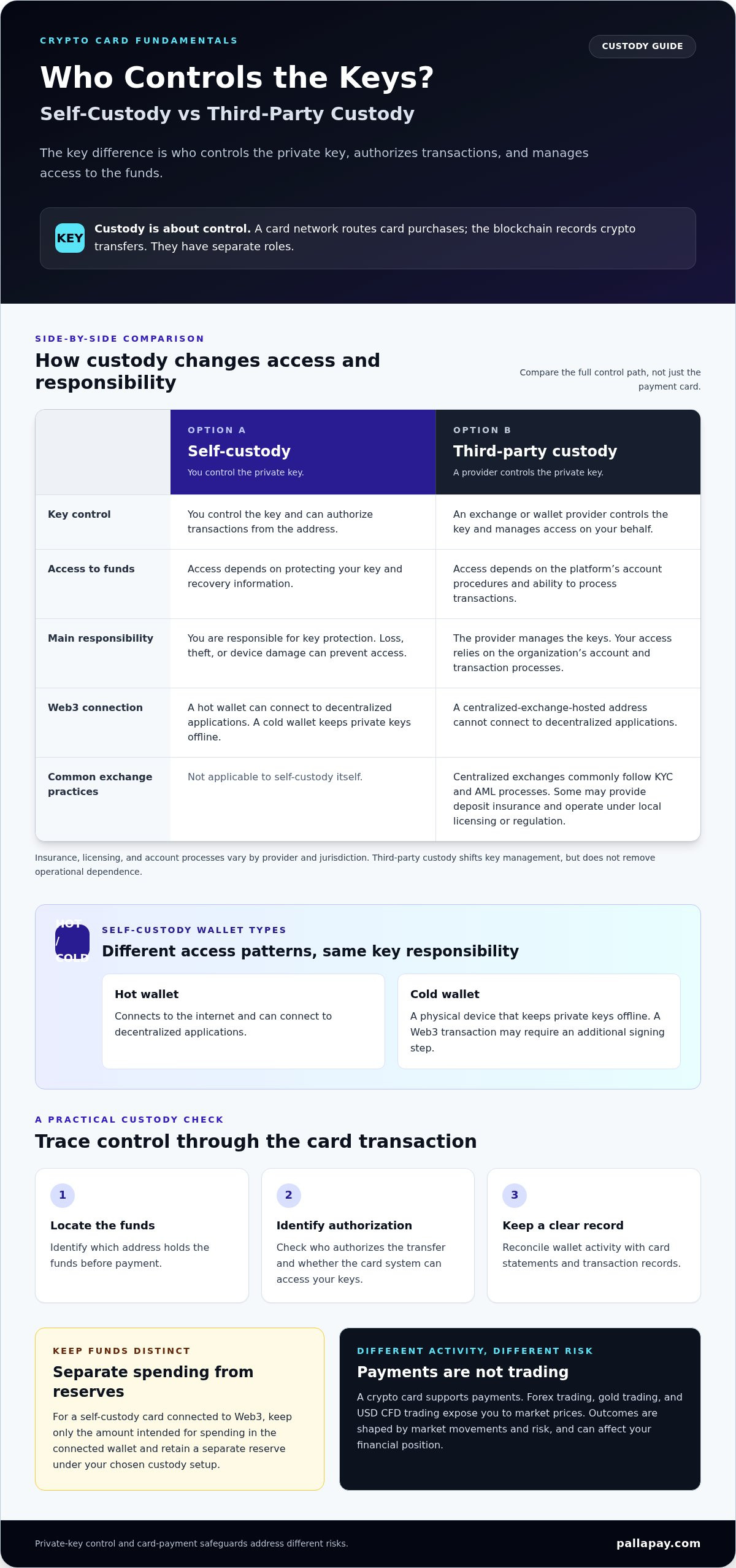
Custody depends on who controls the private key for a crypto address. With self-custody, you control that key and can authorize transactions from the address. With third-party custody, an exchange or wallet provider controls the key and manages access on your behalf. The blockchain records assets at addresses, while wallets manage the keys used to access them.
That distinction determines who can move funds. If you control a Bitcoin address’s private key, you control the assets associated with it. If an exchange controls the key, the exchange manages withdrawals and access through its account processes. A card linked to self-custodied assets therefore raises a key question: does spending preserve your control, or must funds move into an account controlled by an intermediary?
Self-custody offers direct control, but makes key protection your responsibility. A hot wallet connects to the internet and can connect to decentralized applications. A cold wallet is a physical device that keeps private keys offline. Each changes how you access funds: a Web3 transaction may need an online wallet connection, while a cold wallet may require an additional signing step.
Key loss and theft create practical risks. A lost recovery phrase, compromised device, or damaged physical wallet can prevent access to assets. Floods and fires can also damage a device holding keys. Keep spending funds separate from longer-term holdings, and store recovery information separately from the device. Account abstraction can support more user-friendly recovery, but designs vary by wallet and do not remove the need to understand who can authorize access.
Third-party custody shifts key management to an organization. Centralized crypto exchanges commonly follow KYC and AML processes, may provide insurance for user deposits, and operate under licensing or regulation in their jurisdictions. These arrangements can offer account-based access, but the exchange controls the keys. Your access therefore depends on the platform’s account procedures and ability to process transactions.
Compare custody by tracing control through each card transaction. Identify which address holds the funds before payment, who authorizes the transfer, and whether the card system can access your keys. Then distinguish the card’s payment network from the blockchain: Visa or Mastercard routes card purchases, while the blockchain records crypto transfers. These systems have separate roles.
For a self-custody card connected to Web3, assess the balance between direct control and payment convenience. Keep only the amount intended for spending in the connected wallet, and retain a separate reserve under your chosen custody setup. That approach limits the exposure of everyday payments without assuming that either self-custody or third-party custody eliminates operational risk.
Spending crypto through payment cards
A crypto payment card connects digital assets to a familiar checkout process. The card network routes a merchant’s authorization request, while the card program determines how crypto funds the purchase. Crypto may be converted into fiat before authorization or during settlement. That timing affects which balance is used and what records you need to reconcile.
Follow a purchase from start to finish. You present the card at a merchant, the payment network routes the request, and the card program checks whether the payment can proceed. The program then applies its funding method, which may convert supported crypto into the settlement currency. The merchant receives payment through the card system, not directly from your wallet’s crypto.
This distinction matters for Web3 users. A card that connects to a self-custody wallet may use a different setup from one funded by an exchange account or a preloaded balance. The word “connect” does not by itself explain who controls the keys, when funds move, or what permissions the wallet grants. Read the transaction flow and authorization terms as separate parts of the product design.
Card type also changes how spending works:
- Debit card: spending draws from an available balance, which may involve crypto conversion.
- Prepaid card: spending draws from funds loaded onto the card beforehand.
- Credit card: spending uses a credit line, which may be backed by collateral in some crypto products.
Visa and Mastercard are payment networks, not wallet types. Their logos identify the network routing a card transaction, while the issuer and card program determine funding, conversion, and account terms. Acceptance depends on the merchant supporting the network and the card’s regional availability. A network logo alone does not mean a self-custody wallet can connect to the card.
Some regulated centralized crypto exchanges have launched cards with issuing banks, payment networks, and technology providers. Local regulators may require safeguards for these programs. Payment-card programs may include identity checks, transaction records, and procedures for handling reversals. These features relate to payment-card operations, while blockchain transfers follow the rules of their respective networks.
Before using a card, trace three points: which balance funds the purchase, when conversion happens, and where the final transaction appears. Then compare the card statement with wallet activity. A card record may show the merchant charge, while a wallet or blockchain record may show a separate transfer or authorization. This distinction can explain differences between the card amount and the crypto movement.
A self-custody card can simplify everyday spending, but it doesn’t make every purchase a direct Web3 transaction. At a physical or online checkout, the merchant typically processes a card payment through its supported network. A decentralized application, by contrast, interacts with a wallet and blockchain. Keep those two payment paths distinct when assessing access, control, and transaction records.
Card security and chargeback protections
A crypto card combines two security domains: wallet access and card payments. The wallet controls private-key access to crypto, while the card uses payment credentials to authorize purchases. Protecting one does not automatically secure the other. A stolen card credential and a compromised wallet key, for instance, create different risks and require different responses.
Start with the wallet connection. Review the permissions requested when connecting a self-custody wallet to a card service or Web3 application. Grant access only to the function you intend to use, and avoid signing an unfamiliar request. A card transaction should not require you to share a private key or recovery phrase with a merchant.
Separate spending funds from long-term holdings. If a connected wallet contains a large portfolio, a compromised device or unsafe approval could expose more than the amount needed for purchases. Keep a limited spending balance in the connected wallet, and store recovery information separately. A cold wallet keeps private keys offline, while a hot wallet supports internet-connected actions.
Payment-card disputes address a different problem. If a merchant charges the wrong amount or a purchase is unauthorized, the card program’s transaction history can help identify the relevant payment. Web3 card standards include access to transaction records and the ability to reverse transactions. Reversal applies to the card-payment process; it does not necessarily undo a separate blockchain transfer or rewrite its record.
Use the transaction details to distinguish among these cases:
- Unrecognized card charge: identify the merchant, amount, and transaction status in the card record.
- Incorrect merchant amount: compare the receipt with the card transaction before raising a dispute.
- Unexpected wallet movement: review the wallet address and blockchain activity separately from the card statement.
That separation matters because a merchant payment and a wallet transaction may appear in different records. A card reversal can address a payment dispute through the card process, while a crypto transfer requires reviewing blockchain activity and wallet permissions. Keep receipts, card records, and relevant wallet transaction details together when investigating an issue.
Account security also depends on your recovery setup. Losing a private key can prevent access to the crypto at its address, while theft can give another person control of those assets. Account abstraction can support more user-friendly wallet recovery, but the recovery method and its permissions still matter. Understand who can initiate recovery and what access the process restores.
For a self-custodial crypto card, assess security by tracing the full path: wallet permissions, card authorization, transaction records, and dispute handling. Treat chargeback access as protection for card payments, not insurance against lost keys or every blockchain loss. This distinction helps you choose safeguards that match the risk at each step.
Self-custody card rankings, fees, and availability
Compare cards by custody model, supported regions, network, conversion terms, and payment protections. A self-custodial crypto card for Web3 should also be assessed by how its wallet connection and spending permissions work.
Card Rankings and Availability
Rankings order cards according to selected comparison criteria, so their usefulness depends on your priorities.
Compare each card’s stated custody model, supported assets, network, and regional access. A card available in one market may not be offered in another. Check whether it is available where you live and plan to spend. Treat a ranking as a comparison aid, not proof that one card suits every wallet, region, or purchase.
Card Fees
Card fees can apply to issuing, maintaining, funding, or using a card. Comparing fee categories helps reveal costs that a headline charge may not show.
Review the card’s terms for issuance, maintenance, crypto conversion, foreign exchange, and ATM use. Trace a sample purchase from its crypto funding source through settlement. If the purchase currency differs from the settlement currency, a network conversion may apply separately from crypto conversion. Compare the quoted and settled amounts, distinguishing explicit charges from exchange-rate effects.
| Comparison point | What to assess |
|---|---|
| Fees | Issuance, maintenance, conversion, foreign exchange, and ATM charges |
| Network | Visa or Mastercard, plus acceptance where you plan to spend |
| Rewards | Whether cashback applies and which terms govern eligibility |
| Verification | Identity requirements and account setup conditions |
Choosing and Setting Up a Web3 Card
Setup connects a card program to a wallet or funding method. Reviewing the connection first helps you understand the access and permissions it requires.
Confirm regional availability, supported assets, and network before choosing. Identify who controls the private keys and how spending is authorized. Connect the intended wallet, review its requested permissions, and protect recovery details. After setup, review a purchase in the card record and wallet activity to understand how the records relate.
Use the table’s criteria to compare options consistently, then prioritize what matters most. For Web3 access, focus on wallet compatibility; for travel, compare currency treatment and availability. Visa and Mastercard are distinct payment networks, and acceptance can vary by location. Also distinguish debit, prepaid, and credit cards by how each funds a purchase. Explore wallet and asset management options when considering how to organize funds for card spending.
Best Crypto Debit Cards 2026: Visa & Mastercard Compared: crypto debit card
Best Crypto Debit Cards 2026: Visa & Mastercard Compared gives you a practical next step for comparing card options. Use the guide to assess network, regional availability, custody arrangements, conversion mechanics, and fee categories against your spending needs. Visa and Mastercard are separate payment networks, so acceptance and settlement details can differ by card program and location.
If you’re considering a crypto debit card, Pallapay offers the Pallapay Crypto Card alongside services for selling Bitcoin or USDT for cash and buying Ethereum with cash. Compare the card’s stated features with the self-custody requirements discussed above, especially who controls the wallet keys and how transactions are funded.
Visit Pallapay.com to explore the Pallapay Crypto Card and its available features.
Set a Clear Spending Policy for Web3
Choose a self-custodial crypto card for Web3 as part of a deliberate spending policy, not as a replacement for one. Decide what role crypto payments should play in your day-to-day finances, which wallet you intend to use, and how much responsibility you’re comfortable taking for access and recovery. A clear policy makes it easier to assess whether a card fits your habits as they change.
Before acting, write down what matters most to you: convenient spending, control of your assets, and the level of card support you expect. Use those priorities to guide your comparison, then revisit them as your needs evolve. A good decision is one you understand and can manage confidently.
To explore Pallapay’s crypto services and take your next step, visit Pallapay. Continue shaping a self-custodial crypto card Web3 approach that fits your priorities, with clarity and confidence.
Frequently Asked Questions
How Much Do Self-Custody Cards Cost?
Costs depend on the card’s fee structure and how you use it. To estimate your spending, separate fixed charges from costs triggered by specific activity. Fixed charges may include card issuance or account maintenance, while transaction-related costs can arise from currency conversion, crypto conversion, or ATM use. Compare these categories with your expected use, including occasional cash withdrawals, rather than judging by one advertised fee.
What is a self-custodial crypto card and how does it work?
A self-custodial crypto card lets a user spend crypto while retaining control of the wallet’s private keys, depending on the card’s payment design. For example, someone who keeps long-term holdings offline might use a separate wallet balance for routine purchases. The card connects a crypto funding source to conventional card payments, but the merchant generally receives payment through the card network, not directly from the user’s blockchain wallet.
How does a self-custodial crypto card connect to a wallet and authorize payments?
The wallet connection and payment authorization depend on the card’s design. During setup, inspect the wallet address, requested permissions, and any transaction or spending approval before signing. A wallet connection should not require you to share your private key or recovery phrase. If a screen requests authority beyond the intended card use, stop and review what that permission enables before proceeding.
Can users spend stablecoins and cryptocurrencies directly, or are funds converted at checkout?
Cardholders may fund spending with supported cryptocurrencies or stablecoins, but a purchase usually requires conversion into the card’s settlement currency. The timing varies: conversion may happen before authorization or during processing. Holding a dollar-pegged stablecoin, for example, does not mean the merchant receives that token. Check which assets and blockchain networks the card supports, since compatibility affects funding.
Disclaimer
The information provided on this website and blog is for general informational and educational purposes only and does not constitute financial, investment, legal, tax, or other professional advice.
Cryptocurrency and digital asset services may be subject to regulatory restrictions in certain jurisdictions. Users are solely responsible for ensuring compliance with applicable local laws and regulations before using any products or services mentioned on this website.
PallaPay does not guarantee the accuracy, completeness, or timeliness of any information published and accepts no liability for any loss or damages arising from reliance on the content. Any opinions expressed are those of the respective authors and may change without notice.
Certain services, features, or products referenced may be provided through third-party partners, licensed entities, or affiliated service providers subject to separate terms and regulatory approvals. Availability of services may vary by country or region.
This website may contain references to digital assets, virtual currencies, or blockchain-related services that are not available to residents of certain jurisdictions, including where prohibited by law. Nothing on this website constitutes an offer, solicitation, or recommendation to buy or sell any financial instrument or virtual asset.