

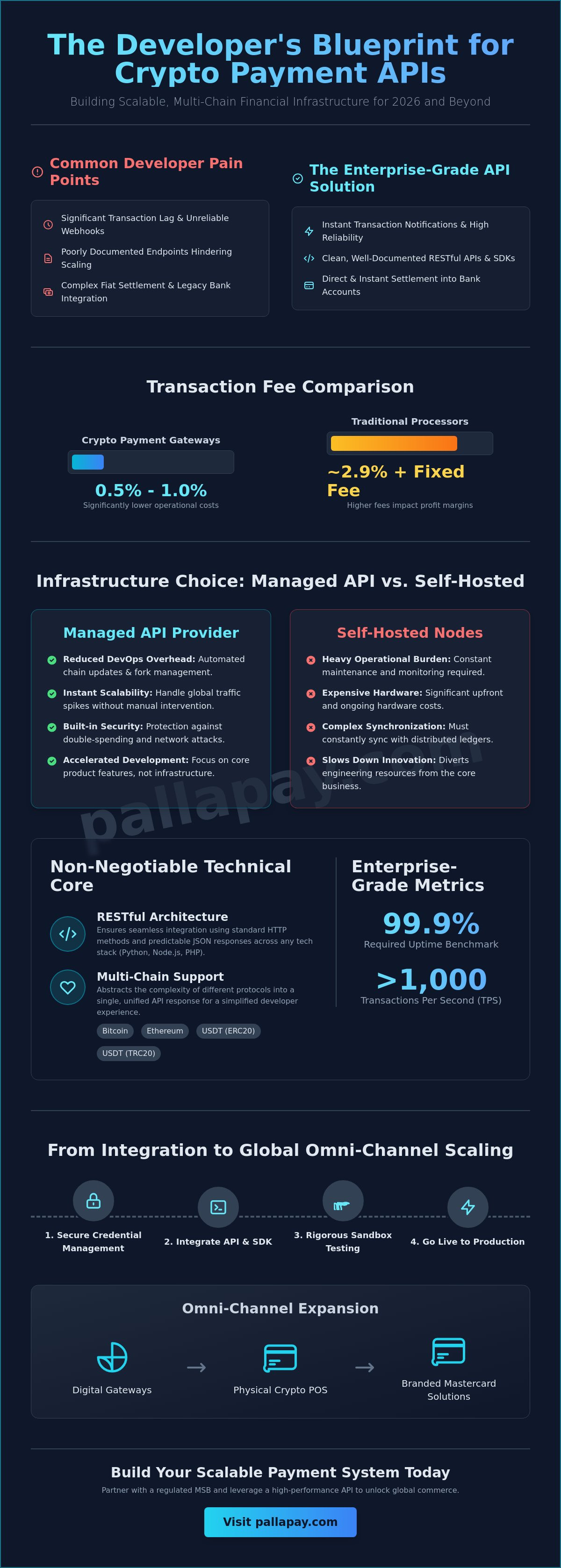
In 2026, a crypto payment API for developers is no longer a peripheral experiment; it’s the essential bridge between decentralized liquidity and institutional financial stability. While transaction fees for crypto gateways now range between 0.5% and 1.0%, significantly lower than traditional processors, the real value lies in the reliability of the underlying infrastructure. You’ve likely faced the operational drag caused by unreliable webhooks, transaction lag, or the complexity of moving funds back into the legacy banking system. It’s frustrating when poorly documented endpoints prevent your application from scaling at the pace of global commerce.
This comprehensive guide provides the technical framework you need to evaluate and integrate enterprise-grade solutions with absolute confidence. You’ll learn how to implement clean, well-documented RESTful APIs and SDKs that offer instant transaction notifications and direct settlement into bank accounts. We’ll also explore how to maintain compliance under the latest MiCA and GENIUS Act frameworks. By the end of this article, you’ll have a clear roadmap for building a scalable, multi-chain payment system that transforms complex technical conversions into standard, effortless business operations.
Key Takeaways
- Understand how the transition to Payments-as-a-Service models allows businesses to move beyond simple wallet transfers toward comprehensive financial infrastructure.
- Learn to integrate a high-performance crypto payment api for developers that utilizes RESTful architecture to support Bitcoin, Ethereum, and multi-chain USDT transactions.
- Discover the strategic advantage of partnering with a regulated MSB to ensure compliant crypto to bank transfers and instant fiat settlement.
- Master the full integration lifecycle, from secure credential management in the merchant dashboard to rigorous sandbox testing for production-ready reliability.
- Explore omni-channel scaling opportunities by connecting digital gateways with physical crypto POS machines and branded Mastercard solutions for real-world spending.
The Role of Crypto Payment APIs in Modern Software Architecture
The evolution of cryptocurrency has shifted from speculative trading to a foundational element of global commerce. In 2026, a crypto payment api for developers acts as a sophisticated “Payments-as-a-Service” layer within modern software architecture. This evolution moves far beyond simple wallet-to-wallet transfers. It integrates complex financial logic directly into the application stack. Developers no longer view blockchain as a separate entity but as a standard microservice that facilitates real-time value exchange with institutional reliability.
Choosing managed API providers over self-hosted nodes is now the industry standard for high-growth companies. This transition eliminates the heavy operational burden of maintaining expensive hardware and constantly synchronizing distributed ledgers. Managed providers offer several critical advantages for the modern dev team:
- Reduced DevOps overhead through automated chain updates and fork management.
- Instant scalability to handle global traffic spikes without manual intervention.
- Built-in security protocols that protect against double-spending and network-level attacks.
By offloading these background processes to a specialized partner, engineering teams can focus on core product features. This strategic shift accelerates the development lifecycle and ensures that the financial infrastructure remains lean and efficient.
Why 2026 is the Year of Institutional Crypto Integration
Institutional adoption has reached a tipping point where digital assets are a standard checkout option. The demand for multi-currency support has surged as users look to spend both volatile assets and stablecoins like USDT. APIs serve as the essential bridge that facilitates cross-border commerce without the traditional friction of intermediary banks. This global reach is especially vital for industries like ecommerce where speed and low fees are competitive requirements. Using a crypto payment api for developers allows businesses to tap into these global markets while maintaining compliance with evolving regulations.
Evaluating API Reliability and Uptime
System availability is the most critical metric for any financial infrastructure. A 99.9% uptime benchmark is no longer optional; it’s a requirement for enterprise trust. Leading providers use redundant node clusters to ensure API responsiveness even during periods of heavy network congestion. You should verify that your provider can handle high-throughput scenarios, often exceeding 1,000 transactions per second. Reliable infrastructure ensures that every payment request is processed instantly. This consistency maintains the momentum of your business operations and prevents the loss of customer trust during the checkout process.
Technical Core: RESTful Architecture and Multi-Chain Support
Building a resilient financial application requires an architectural foundation that prioritizes predictability and interoperability. A modern crypto payment api for developers utilizes a RESTful structure to ensure that integration remains seamless across diverse tech stacks, whether you’re working with Python, Node.js, or PHP. This design choice allows for standard HTTP methods and JSON responses, making the integration process intuitive for engineering teams. By using a unified interface, you can manage complex blockchain interactions without needing to master the specific nuances of every underlying protocol.
Multi-chain capability is a non-negotiable requirement in 2026. Your infrastructure must support a broad spectrum of assets, including Bitcoin, Ethereum, and stablecoins like USDT on both ERC20 and TRC20 networks. Abstracting the complexities of these different protocols into a single API response simplifies the developer experience. Accessing real-time exchange rates and network fee estimations through the same interface ensures that your users always see the most accurate pricing during the checkout flow. For those looking to implement these features immediately, exploring a professional API for crypto payments provides the necessary tools to get started.
In financial processing, the concept of idempotency is vital. It ensures that if a request is sent multiple times due to a network timeout, the transaction is processed only once. This prevents the nightmare of duplicate charges or inconsistent database states. As global Cryptocurrency Regulation matures, maintaining these high standards of technical precision becomes both a legal and operational necessity. It builds a layer of trust that users expect from institutional-grade financial services.
Webhook Management and Transaction Callbacks
Reliable payment processing depends on secure, real-time communication between the gateway and your application. Implementing secure webhooks requires signature verification to prevent malicious spoofing attempts. Your system should also allow for custom threshold settings regarding network confirmations. This flexibility lets you decide when a payment reaches finality based on your specific risk tolerance. Automatic retry logic ensures that even if your server experiences a brief hiccup, you’ll never miss a successful payment notification.
Security Protocols: Protecting the Developer Pipeline
Protecting the developer pipeline is as important as securing the transactions themselves. Best practices involve environment-based access control, where sandbox and production environments use distinct API keys. You should implement IP whitelisting and role-based access for sensitive withdrawal endpoints to minimize the attack surface. End-to-end encryption for transaction metadata ensures that sensitive user information remains private. These layers of defense create a secure environment that allows for rapid innovation without compromising on safety.
Strategic Differentiators: Compliance and Fiat Settlement
Developers often struggle with the legal gray areas of digital asset management. A robust crypto payment api for developers solves this by prioritizing a “Compliance First” architecture. Registration as a Money Service Business (MSB) in the United States and Canada isn’t just a badge; it’s an operational guarantee. It ensures that every transaction processed through your application adheres to strict federal standards. This institutional reliability is what separates professional-grade infrastructure from experimental gateways. It allows you to offer your users the stability they require for high-volume commerce.
Bridging the gap between non-crypto-native businesses and digital liquidity requires sophisticated conversion tools. Automated fiat settlement eliminates the volatility risks that often deter traditional merchants. Instead of holding volatile assets, businesses can receive funds directly in their local currency. This process is streamlined by integrated KYB (Know Your Business) protocols. These API-driven verification flows allow for rapid merchant onboarding while maintaining full regulatory integrity. It transforms what used to be a complex legal hurdle into a standard, automated background process.
Direct Crypto-to-Bank Transfers
Scaling a global enterprise requires efficient ways to manage payroll and vendor payments. Enabling crypto to bank transfers directly through an API allows for seamless off-ramping into major fiat currencies like USD, EUR, AED, and INR. While traditional systems often rely on T+3 settlement windows, modern infrastructure is pushing toward instant availability. This transition is essential for maintaining a healthy cash flow in fast-paced markets. It empowers developers to build applications that function as a professional bridge between diverse financial ecosystems.
Navigating Global Regulations
Operating across 180 countries requires a deep understanding of localized legal requirements. For example, the Oregon cryptocurrency payment law demonstrates how regional frameworks are beginning to define the scope of digital transactions. Pallapay handles these complexities for developers by embedding AML (Anti-Money Laundering) monitoring into every API transaction flow. This proactive approach ensures that your application remains compliant without requiring you to build an in-house legal department. Automated transaction exports also simplify tax reporting, providing a clean audit trail for every global operation.
Developer Experience: Streamlining the Integration Lifecycle
A sophisticated crypto payment api for developers must prioritize the developer experience as much as the transaction throughput. The integration lifecycle begins in the merchant dashboard where you generate your unique API keys. This centralized hub serves as your command center, providing immediate access to the credentials required for secure communication. Once keys are secured, the transition to the sandbox environment allows you to simulate both successful and failed transaction scenarios without risking real capital. It’s an essential safety net that ensures your logic is sound before moving to a live environment.
Configuring webhook listeners is the next critical phase in building a real-time financial application. Instead of inefficient polling, webhooks provide instant notifications for order updates; this allows your system to react immediately to payment finality. You can then choose to customize the checkout UI to match your brand’s aesthetic or utilize pre-built payment widgets for a faster time-to-market. Monitoring transaction health in production completes the cycle, ensuring that your infrastructure remains performant as you scale. If you’re ready to begin your integration, you can access the developer portal to see these tools in action.
Documentation and SDKs
Clarity in documentation is the hallmark of a professional financial partner. We provide ready-to-use code snippets for Node.js, Python, and PHP to accelerate your development timeline. For instance, recent early 2026 updates to the Python Unified SDK v8.0.1 and PHP Unified SDK v10.1.2 ensure compatibility with the latest security standards. Using Swagger or OpenAPI specifications allows for automated client generation, reducing the likelihood of manual errors. Enterprise clients also benefit from dedicated integration managers who provide direct support throughout the deployment process.
Customizing the User Journey
Maintaining brand consistency is vital for building user trust during the payment process. White-labeling options allow you to keep the experience seamless, ensuring that the checkout flow feels like a natural extension of your platform. You can also generate flexible payment links for social media or email invoicing, providing a low-friction way for customers to settle balances. For businesses looking to expand their utility, integrating gift card issuance directly into the checkout flow adds a layer of versatility that traditional gateways often lack. This comprehensive approach ensures that every touchpoint is optimized for conversion and growth.
The Pallapay Advantage: Building for Global Scale
The definitive advantage of a crypto payment api for developers lies in its ability to transcend the digital screen and integrate with the physical world. While many providers stop at the checkout page, our ecosystem bridges the gap between digital asset processing and tangible commerce. By integrating with crypto POS machines, developers can build omni-channel solutions that unify online sales with retail storefronts. This holistic approach is further enhanced by the issuance of Pallapay Mastercards. These cards enable users to spend API-processed funds in the real world instantly. It’s a complete lifecycle that transforms digital liquidity into practical, everyday utility.
Institutional operations often involve high-volume settlements that exceed standard gateway limits. Our OTC crypto exchange desks provide the necessary liquidity for these large-scale movements, ensuring that even the most significant transactions are handled with professional precision. This combination of high-throughput API access and institutional OTC support positions Pallapay as the definitive destination for 2026 crypto-fiat operations. It’s about providing the tools needed for global scale. We handle the complex background processes so you can focus on expansion.
Omni-channel Payments for Retail and Hotels
For industries such as hospitality, the division between booking and check-in often creates data silos. Modern hotels use the API to secure online reservations and then utilize physical POS terminals for on-site services. This unifies all transaction data into a single dashboard, providing a clear view of business health. This same infrastructure allows ecommerce platforms to scale rapidly, utilizing high-availability servers that handle global traffic without interruption. Efficiency is the priority. Your data remains synchronized across every touchpoint.
The Future of the Pallapay Ecosystem
The Pallapay roadmap includes expanding Layer 2 scaling support and deeper DeFi integrations to keep your application at the forefront of innovation. Security remains the cornerstone of our progress. We apply rigorous protection standards to the Pallapay wallet and the entire API infrastructure to safeguard institutional assets. The evolution of global finance is inevitable. It’s a shift toward a more integrated, efficient, and borderless system. You can start building with Pallapay today to ensure your business is part of that future.
Empowering Global Commerce with Institutional-Grade Infrastructure
The financial landscape of 2026 demands more than a simple gateway; it requires a resilient bridge between digital assets and traditional banking systems. By selecting a high-performance crypto payment api for developers, you gain access to a platform that prioritizes regulatory compliance and technical precision. We’ve detailed how MSB registration in the US and Canada provides the security foundation your enterprise needs to scale. You’ve also seen how RESTful architecture and instant fiat settlement options eliminate the operational friction typically associated with blockchain transactions.
This infrastructure facilitates seamless operations across 180 countries, ensuring your application is ready for immediate global deployment. Whether you’re unifying online checkouts with physical POS machines or enabling real-world spending via integrated Mastercards, the tools for success are now at your fingertips. It’s time to transform complex background processes into standard business operations.
Build Your Future with Pallapay: Get Your API Key
The evolution of finance is happening now, and your business is ready to lead the way.
Frequently Asked Questions
What is a crypto payment API and how does it work for developers?
A crypto payment API is a set of RESTful endpoints that allows software to interact with blockchain networks for automated payment processing. Developers use these tools to generate unique payment addresses, monitor incoming transactions in real time, and manage fund settlements. It abstracts the complexity of node maintenance and ledger synchronization into a single, reliable integration layer that connects directly to your application stack.
Which cryptocurrencies can I accept through the Pallapay API?
You can accept major digital assets including Bitcoin, Ethereum, and USDT across multiple network standards such as ERC20 and TRC20. The platform is engineered for broad utility, allowing your application to support the most liquid assets currently utilized in global commerce. This ensures your customers have the flexibility to pay with their preferred digital assets while you maintain a unified transaction record.
How do I ensure the security of my crypto API integration?
Security is maintained through environment-based API key management, IP whitelisting, and mandatory signature verification for all incoming webhooks. You should implement role-based access controls for sensitive withdrawal endpoints and utilize end-to-end encryption for all transaction metadata. These layers of defense prevent unauthorized access and ensure the absolute integrity of your financial data within the developer pipeline.
Can I settle crypto payments directly into my local bank account?
Yes, the system facilitates direct crypto to bank transfers into local accounts in major currencies like USD, EUR, GBP, and AED. This feature allows businesses to convert digital assets into fiat instantly, effectively bypassing the volatility often associated with holding cryptocurrencies. It creates a professional bridge between modern digital payments and your established local financial institutions for seamless cash flow management.
What are the transaction fees for using a professional crypto payment gateway API?
Industry transaction fees for professional gateways typically range between 0.5% and 1.0%, which is significantly lower than traditional credit card processors. While specific costs depend on your transaction volume, using a crypto payment api for developers reduces the overhead associated with intermediary banks. You can monitor your specific settlement costs through the merchant dashboard to maintain full transparency over your operational expenses.
Does Pallapay support stablecoins like USDT and USDC for business payments?
Pallapay provides extensive support for USDT on various chains to facilitate stable, low-volatility business transactions for global merchants. Stablecoins are essential for businesses that require price certainty during the settlement process. The platform ensures these assets are processed with high-speed reliability, making them ideal for high-volume operations such as global payroll or vendor payments without the risk of market fluctuations.
How does webhook notification work in a crypto payment flow?
Webhooks function as automated callbacks that send real-time data from the gateway to your server when a transaction status changes. When a payment is detected or reaches the required confirmation threshold on the blockchain, the API pushes a POST request to your listener. This eliminates the need for inefficient manual polling and ensures your application reacts instantly to provide a smooth customer experience.
Is MSB registration necessary for companies providing crypto payment APIs?
MSB registration is a critical legal requirement for providers operating in regions like the US and Canada to ensure AML and KYC compliance. It signifies that the provider is a regulated financial entity, offering institutional trust and legal protection for the developers using their infrastructure. Partnering with a registered MSB is essential for maintaining a compliant, high-volume operation that meets global financial standards.
Disclaimer
The information provided on this website and blog is for general informational and educational purposes only and does not constitute financial, investment, legal, tax, or other professional advice.
Cryptocurrency and digital asset services may be subject to regulatory restrictions in certain jurisdictions. Users are solely responsible for ensuring compliance with applicable local laws and regulations before using any products or services mentioned on this website.
PallaPay does not guarantee the accuracy, completeness, or timeliness of any information published and accepts no liability for any loss or damages arising from reliance on the content. Any opinions expressed are those of the respective authors and may change without notice.
Certain services, features, or products referenced may be provided through third-party partners, licensed entities, or affiliated service providers subject to separate terms and regulatory approvals. Availability of services may vary by country or region.
This website may contain references to digital assets, virtual currencies, or blockchain-related services that are not available to residents of certain jurisdictions, including where prohibited by law. Nothing on this website constitutes an offer, solicitation, or recommendation to buy or sell any financial instrument or virtual asset.