

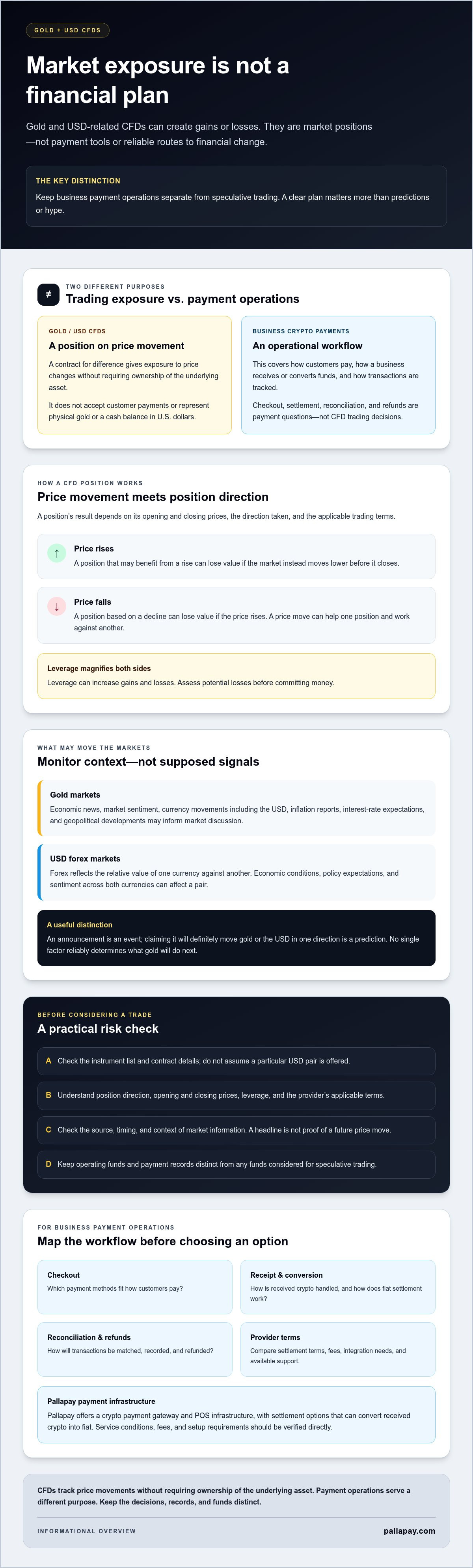
Could a move in gold or the U.S. dollar support a financial plan, or magnify a loss? If you’re learning how to manage crypto payments for a business, keep that operational task separate from CFD trading. Gold and USD CFDs are leveraged market positions, not payment tools or reliable routes to financial change.
For a business that accepts cryptocurrency, the practical questions are different: which payment method fits your checkout, how received crypto is handled, how any fiat settlement works, and how transactions are recorded. CFDs track price movements without requiring ownership of the underlying asset, and leverage can increase both gains and losses. A clear plan matters more than predictions or hype.
This guide explains the distinction between payment operations and gold or USD CFDs, then outlines practical steps for managing crypto payments and assessing trading risk. You’ll learn what to check about payment processing, settlement, fees, records, and trading terms before making decisions. The aim isn’t to promise a result; it’s to help you identify what your business needs and what risks it can afford to take.
Key Takeaways
- Gold and USD-related CFDs are market positions, while crypto payments are part of a business’s payment operations. Don’t treat one as a substitute for the other.
- Before accepting crypto, decide how payments will fit into checkout, settlement, reconciliation, and refund processes.
- Compare payment options by checking supported payment methods, conversion and settlement terms, fees, integration needs, and available support.
- Keep operating funds and payment records distinct from any funds considered for speculative trading. Assess potential losses before committing money.
- Pallapay offers a crypto payment gateway and POS infrastructure, with settlement options that can convert received crypto into fiat. Verify current service conditions, fees, and setup requirements directly.
What Gold and USD CFDs Are, and What a Business Is Actually Trading
A contract for difference (CFD) gives a trader exposure to changes in an asset’s price without requiring ownership of that asset. A gold CFD follows gold’s market price, while a USD-related forex CFD follows movement in a currency pair involving the U.S. dollar. The position’s result depends on the difference between its opening and closing prices, the direction taken, and the applicable trading terms. The Contract for Difference (CFD) reference provides background on the structure and risks of these contracts.
For a company, a CFD position is market exposure, not a way to accept customer payments or hold physical gold or currency. Questions about how to manage crypto payments for a business concern payment operations: how customers pay, how the business receives or converts funds, and how transactions are tracked. Keep those purposes, records, and funds clearly distinguished.
How a gold CFD position follows the gold market
A gold CFD position changes in value as the referenced gold price moves. A position that may benefit from a rise can lose value if the price falls; a position based on a decline can lose value if the price rises. The size of the effect depends on the position and its terms, which must be checked with the provider.
For example, imagine a business decision-maker opens a hypothetical position expecting gold to rise. If the market instead moves lower before the position closes, the position may produce a loss. This example illustrates how direction affects a CFD; it isn’t a forecast or recommendation. A CFD doesn’t give the trader ownership of physical gold. It also doesn’t help a business process a customer’s crypto payment.
What USD-related forex CFD exposure means
Forex prices express the value of one currency in relation to another. In a currency pair, the USD may be the first or second currency, and a price movement reflects a change in their relative values. A USD-related CFD therefore creates exposure to that movement, not necessarily to a cash balance held in U.S. dollars.
The position doesn’t itself mean the trader has exchanged or taken delivery of physical currency. Instrument availability and contract details vary, so don’t assume a particular pair is offered. Check the current instrument list and terms before considering any trade. Separately, a company managing crypto payments should establish how payment acceptance and settlement fit its operations rather than treating speculative exposure as part of routine payment processing.
How Gold and USD CFD Prices Move, and What Can Change a Position
Gold and currency markets move as buyers and sellers respond to changing information, expectations, and trading conditions. An open CFD position is affected by the market’s movement relative to its direction: the same price change can benefit one position and work against another. The result also depends on the contract’s terms, so price direction alone doesn’t establish the eventual outcome.
As the market price of the referenced asset changes, an open CFD position’s value can change too, creating a potential gain or loss according to the position’s direction and applicable contract terms. This is why traders need to distinguish an observed event from a forecast. A central-bank announcement, for example, is a market event; claiming it will definitely push gold or the USD in one direction is a prediction, not a fact.
Factors traders may monitor in gold markets
Gold prices may respond to economic news, shifts in market sentiment, and movements in currencies, including the USD. Inflation reports, interest-rate expectations, and geopolitical developments can also inform market discussion, but no single factor reliably determines what gold will do next. Treat each as a research prompt, not a trading signal.
Before making a decision, check the source, timing, and context of current information. Then consider whether the market has already reacted and whether other developments may be relevant. A headline can explain what traders are discussing without proving how prices will move.
Factors traders may monitor in USD forex markets
Forex prices reflect the relative value of one currency against another. That value can shift as economic conditions, policy expectations, and market sentiment change across both currencies in a pair. Economic announcements may trigger volatility, meaning prices can move more sharply or less predictably, but an announcement isn’t a reliable instruction to buy or sell.
Focus on verified data and the market’s actual response rather than assuming a result in advance. Check current information and the relevant instrument’s terms before acting; don’t assume a specific USD currency pair is available. The risks of CFD trading include the possibility that rapid market changes may work against an open position, so research should support risk planning rather than confidence in a forecast.
Payment decisions call for a different kind of review. To manage crypto payments for a business, map the path from customer checkout to the business’s records and any fiat settlement. Confirm how each step works with the provider instead of relying on assumptions about conversion, timing, or transaction status.
Can Gold and USD CFD Trading Transform Your Finances? Risk Comes First
Gold and USD CFDs can provide exposure to market movements, but access to a market isn’t a reliable route to lasting financial change. A position may gain or lose value, and no strategy or market view can guarantee a positive result. CFD trading outcomes are uncertain, and no profit or financial transformation is assured.
Consider any potential benefit alongside its limits. CFDs may let a trader take a view on price movements without owning the underlying asset, but that exposure can also produce losses, and contract terms may include costs that affect the outcome. Market access doesn’t remove uncertainty or make trading a substitute for stable business income, sound financial planning, or funds needed for normal operations.
Potential advantages and limitations of CFD exposure
CFD exposure may offer a way to participate in gold or currency price movements without holding physical gold or exchanging physical currency. The trade-off is that the position remains exposed to market changes, and you may lose money if prices move against it. Any flexibility depends on the actual instrument and provider terms, which must be checked rather than assumed.
For payment operations, compare services by the tasks your business needs to handle. A crypto payment gateway can support online acceptance, while a crypto POS machine can support in-person payments. Before choosing either, check how it fits your checkout, what payment and settlement options are available, what fees apply, and what configuration or ongoing requirements the service involves. These are operational decisions, separate from speculative trading.
Why leverage and loss limits need careful attention
Leverage can create market exposure greater than the funds committed to a position. That can amplify the impact of price movements in either direction, so an adverse move may have a meaningful effect on the funds at risk. The exact mechanics depend on the provider’s terms. Verify leverage, margin requirements, charges, and how a position may be closed before trading.
Set an exposure limit in advance and decide what loss you could withstand without disrupting personal or business obligations. Position sizing and predefined exit points can help structure decisions, but neither prevents every loss or guarantees an exit at a particular price. Don’t use operating funds or money needed for essential expenses to pursue a possible trading gain. Keep payment operations and speculative trading separate, and seek independent financial guidance if the potential downside is unclear.
A Practical Framework for Managing Gold and USD CFD Decisions
A repeatable process can help keep gold and USD CFD decisions aligned with a clear purpose. It won’t remove market risk or prevent losses, and it isn’t individualized financial advice. Use this framework to organize your questions before considering a position:
- Define the purpose. Decide what role, if any, trading could have in your broader financial plan. If the objective is unclear, pause rather than trade in response to market hype.
- Research the market and instrument. Review current information relevant to the asset, and distinguish verified facts from forecasts. Confirm the specific instrument is available and understand how its terms work.
- Set an exposure limit. Decide in advance what amount you could afford to lose without affecting essential obligations. Consider how leverage, margin requirements, and position size may change the potential impact.
- Review the position. Set a process for checking whether conditions or your original reasoning have changed. Don’t treat a short-term price move as proof that the original decision was sound or unsound.
- Record the decision. Document your rationale, timeframe, exposure, and eventual outcome. Use the record to evaluate your process and identify assumptions that need review.
For a business, separate operating funds from any funds considered for speculative trading. Money needed for payroll, suppliers, taxes, or other essential commitments shouldn’t be treated as risk capital. Separately, create a clear process for crypto payments: decide who oversees payment settings, how transactions are matched to sales, how conversion and settlement are recorded, and how staff handle questions or exceptions. Don’t combine payment controls with CFD decisions.
Set an objective and a manageable exposure limit
Ask what trading is intended to accomplish and whether that purpose fits your wider financial plan. Set a maximum acceptable loss as a planning boundary, not as a promise about the amount you’ll lose. Actual outcomes can depend on market movements and contract terms. If the possible downside is unclear, don’t commit funds until you’ve checked the relevant details and considered whether the risk is appropriate for you.
For crypto payment management, start with the business’s actual payment needs. An online seller may need a gateway that fits its checkout process; a business taking payments in person may want to assess POS infrastructure. In either case, confirm the available payment and settlement options, fees, integration or setup needs, and service conditions. Pallapay offers a crypto payment gateway and POS infrastructure; check current details directly before choosing a setup.
Review decisions and keep a clear trading record
For a CFD decision, record why you considered a trade, what timeframe you had in mind, what exposure you chose, and what happened. Review whether you followed your stated process, not only whether the position gained or lost. Reassess your assumptions if market conditions or your financial objectives change; a past outcome doesn’t guarantee a future one.
For business payments, keep transaction records that let you match customer payments with sales and reconcile any settlement. Check how the provider describes transaction status, fees, conversion, and settlement so your records reflect the actual process. To review Pallapay’s payment services, review the available service information and verify current terms before taking any next step.
How to Evaluate Pallapay’s Forex and CFD Offering Before Taking Next Steps
A business choosing a crypto payment service should verify the specific products and terms it needs. Pallapay offers a crypto payment gateway and POS infrastructure, and its services include settlement options for converting received crypto into fiat. Check directly which options are available for your requirements; don’t assume a general service description confirms a particular integration, payment method, or settlement condition.
Review the full payment workflow before adopting a service. Identify where customers will see the payment option, how the payment is confirmed, how the business will track it, and how settlement is handled. Check what fees apply, including transaction charges and any charges for converting received crypto into local bank deposits. For POS, ask about hardware purchase and configuration, as well as any ongoing maintenance or software licensing fees that may apply.
Questions to verify before using a trading service
Use these questions to guide a review of payment services and, where relevant, any separate trading service:
- For payments, does the gateway or POS setup fit the way your customers pay, and what options are currently available?
- How does settlement work, what fees or conversion charges apply, and what information will your business need for reconciliation?
- For POS, what hardware, setup, maintenance, or software licensing requirements apply?
- For any separate trading service, are gold and USD-related CFDs currently available to you, and what fees, leverage conditions, margin requirements, and service terms apply?
Confirm the answers in current, authoritative service information rather than relying on assumptions or promotional descriptions. If a term is unclear, ask for clarification before committing funds or configuring a payment process. The ability to accept a payment or place a trade doesn’t establish that the service fits your business needs.
Choose a considered next step, not a promised outcome
Compare verified payment terms with your checkout requirements, accounting process, settlement preferences, and capacity to manage the service. If you’re also considering speculative trading, keep that decision separate from payment operations and keep trading funds separate from money needed for business obligations. Payment processing and CFD exposure have different purposes and risks.
No payment service or trading tool can assure a particular financial outcome. If Pallapay’s confirmed payment services and terms fit your needs, explore Pallapay’s current services and review the details before deciding whether to proceed.
Make Your Next Trading Decision Deliberate
Gold and USD CFDs create exposure to price movements, not ownership of gold or currency. Their outcomes are uncertain, and leverage can magnify both gains and losses. A clear purpose, careful research, defined exposure limits, and regular review can help you make more considered decisions, but no process can prevent every loss or guarantee a result.
Managing crypto payments is a separate operational challenge. Decide how customers will pay, how payment records will be reconciled, and how settlement will work. Keep payment processes and funds needed for operations distinct from any speculative trading activity.
Pallapay offers a crypto payment gateway and POS infrastructure, including settlement options that convert received crypto into fiat. Confirm current availability, fees, setup requirements, and service conditions directly. If you’re ready to review the payment options, explore Pallapay’s current services.
Move forward with clear questions, realistic expectations, and a payment process your business can review and manage.
Frequently Asked Questions
Is gold CFD trading suitable for beginners?
Beginners should first understand that a gold CFD tracks price movements and doesn’t mean owning gold. A position can result in a loss as well as a gain, and leverage may increase exposure. Learn how the contract works, review all applicable terms, and consider whether the risk fits your circumstances before proceeding. This is general information to support your research, not a personal recommendation.
Can USD CFDs change a business’s financial position?
Yes, USD-related CFD trading may affect a business’s finances, but the direction and size of any outcome are uncertain. Losses are possible, so trading shouldn’t be treated as dependable operating income or a guaranteed route to financial change. Before acting, assess the business’s objectives, available funds, and capacity for risk. Then verify that the instrument is available and review the current service terms.
How does a gold CFD work?
A gold CFD provides exposure to changes in gold’s market price without requiring the trader to own physical gold. The position’s outcome depends on how the price moves relative to its direction, along with applicable costs and contract terms. A hypothetical example can illustrate the mechanics, but it can’t predict future prices or show whether a particular trade is suitable for you or your business.
What affects USD forex CFD prices?
USD forex CFD prices change as currency markets respond to evolving conditions and shifts in the relative values of currencies. Economic information and market sentiment may be relevant, but neither guarantees a particular price direction. Verify current market information and understand the specific instrument you’re considering. Avoid treating a single announcement, headline, or indicator as a certain trading signal or a substitute for assessing risk.
Can leverage increase losses in CFD trading?
Yes, leverage can increase market exposure relative to the funds committed, so an adverse price movement may have a greater effect on a position. The precise impact depends on the instrument and applicable terms, which you should verify directly before trading. Leverage doesn’t assure a better outcome. Position limits and other risk-management measures may help structure decisions, but they can’t guarantee that losses will be avoided.
What should a business check before using a CFD trading service?
A business should confirm whether the relevant instruments are currently available and review applicable fees, leverage terms, platform functions, and service conditions. Keep any funds considered for trading separate from money needed for essential operations. Managing crypto payments for a business is a separate operational task, not confirmation of any trading feature. Don’t assume general service descriptions establish specific product features, protections, or suitability.
Does trading gold or USD CFDs guarantee profits?
No. CFD trading involves uncertain market movements, and a position can lose value as well as gain value. Past price movements and hypothetical examples don’t guarantee future outcomes. Before considering a trade, learn how the product works, verify the provider’s current terms, and assess whether the potential downside is acceptable for your circumstances. Don’t rely on trading as a guaranteed way to change your financial position.
Disclaimer
The information provided on this website and blog is for general informational and educational purposes only and does not constitute financial, investment, legal, tax, or other professional advice.
Cryptocurrency and digital asset services may be subject to regulatory restrictions in certain jurisdictions. Users are solely responsible for ensuring compliance with applicable local laws and regulations before using any products or services mentioned on this website.
PallaPay does not guarantee the accuracy, completeness, or timeliness of any information published and accepts no liability for any loss or damages arising from reliance on the content. Any opinions expressed are those of the respective authors and may change without notice.
Certain services, features, or products referenced may be provided through third-party partners, licensed entities, or affiliated service providers subject to separate terms and regulatory approvals. Availability of services may vary by country or region.
This website may contain references to digital assets, virtual currencies, or blockchain-related services that are not available to residents of certain jurisdictions, including where prohibited by law. Nothing on this website constitutes an offer, solicitation, or recommendation to buy or sell any financial instrument or virtual asset.