

Forex trading, gold CFDs, and USD CFDs let traders take positions on market price movements, but each carries financial risk. Forex trading involves currency pairs, while gold and USD CFDs provide exposure to price changes without requiring ownership of the underlying assets.
These markets can offer opportunities when prices move as expected, but they can also lead to losses when prices move against a position. Leverage can magnify the impact on an account, so understanding your exposure is essential to every trading decision.
Learn how currency pairs work, what can move gold and USD prices, and how CFD trading may affect your finances. This overview explains the market basics and key risks to consider when making trading decisions.
Key Takeaways
- Understand how forex traders exchange currency pairs and how movements in one currency affect the other.
- Learn how gold CFD price changes can present trading opportunities while also creating exposure to losses.
- Identify economic and market factors that can influence the US dollar in CFD trading.
- Assess how leveraged trading may affect personal finances and why managing exposure matters.
- Use a clear risk plan to align trading decisions with your financial goals and capacity for loss.
Forex Trading: How Currency Markets Work
Forex trading involves buying one currency and selling another through a currency pair. A trader takes a position on how the currencies’ relative values may change. Forex traders can also use CFDs to gain exposure to currency, gold, or USD price movements without directly holding the underlying assets.
Each pair has a base currency and a quote currency. The base currency appears first and the quote currency second. The price shows how much of the quote currency is needed to buy one unit of the base currency. If a trader expects the base currency to strengthen against the quote currency, they may buy the pair. If they expect it to weaken, they may sell the pair.
Every forex position is comparative. A trader is not simply deciding whether a currency is strong or weak on its own, but whether it may gain or lose value against its counterpart. A currency can rise against one counterpart and fall against another because each pair reflects different economic conditions and market expectations.
Currency prices respond to factors that affect demand or expectations about future value. These include central bank decisions, interest-rate expectations, inflation, economic data, political developments, and broad shifts in investor sentiment. The same announcement can affect pairs differently, depending on the countries involved and what traders had already anticipated.
Forex traders commonly consider three related questions before taking a position:
- Which currencies are being compared? The pair determines the economic and market factors most relevant to the trade.
- What could move their relative value? Traders assess upcoming information and changing expectations rather than relying on a single signal.
- What happens if the market moves the other way? A position can lose value when the exchange rate changes against the trader’s expectation.
The global currency market operates across financial centres, with prices changing as trading activity and new information affect supply and demand. A quoted rate is a snapshot of a pair at a particular moment, not a fixed value available indefinitely. Timing matters because an order may execute at a different rate from the one first observed, especially when the market is moving.
Forex exposure can also come through contracts for difference (CFDs). A CFD tracks price movements without requiring the trader to exchange and hold both currencies directly. Gold CFDs and USD CFD trading can also provide exposure to price movements without owning the underlying asset. These contracts can provide access to rising or falling markets, but losses can occur when the price moves against the position. Leverage, when used, magnifies the effect of market movements on the account, making exposure and risk controls central to the decision.
Understanding currency pairs can help traders assess forex and CFD exposure. It shows why an exchange rate always compares one currency with another, and why a position’s outcome depends on the rate at the time of the trade and how it changes. Forex trading, gold CFDs, and USD CFD trading may affect a trader’s financial life, but they carry the risk of losses, including when market movements go against expectations.
Trading Gold CFDs
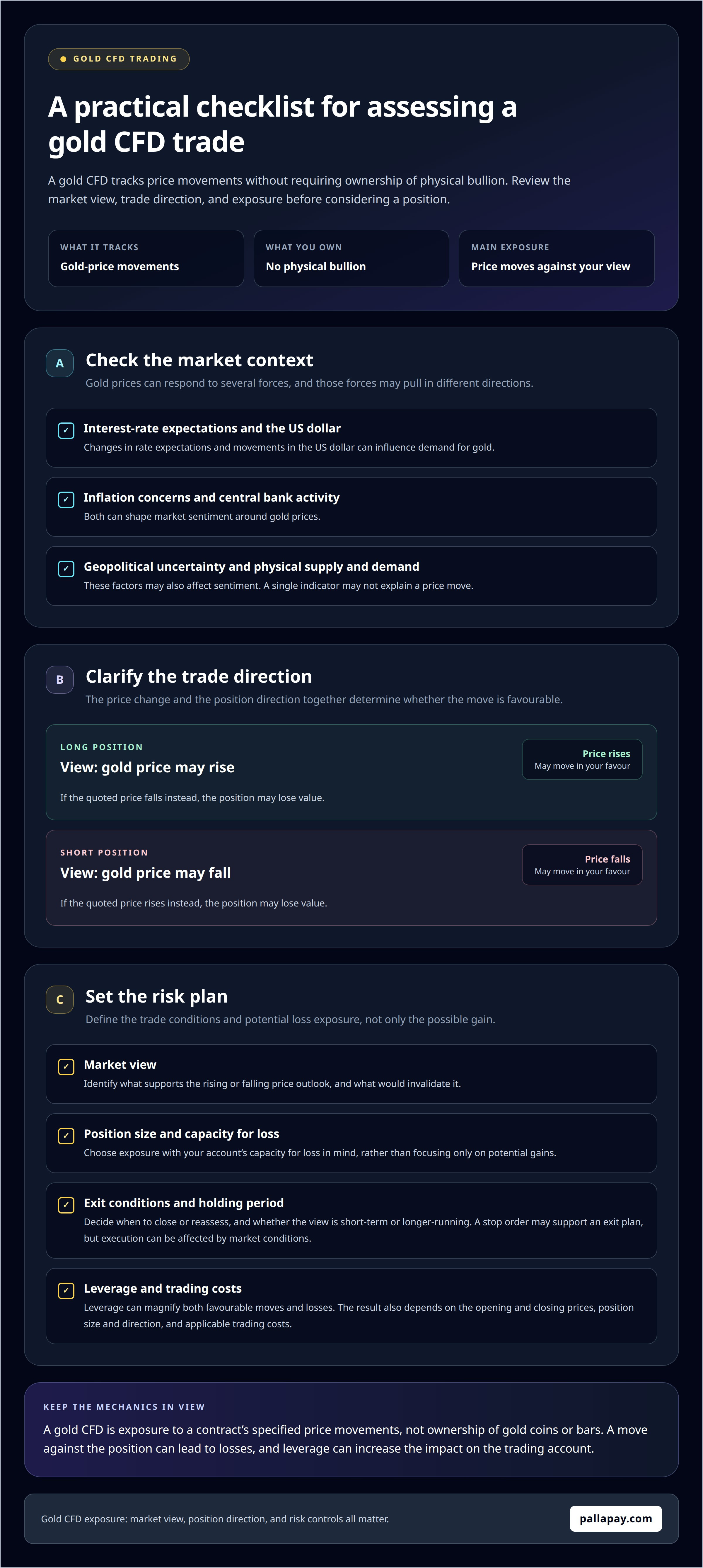
A gold contract for difference (CFD) lets a trader take a position on gold-price movements without buying or holding physical bullion. The trader chooses whether to open a position that may benefit from a rise or a fall in the quoted price. If the market moves in the chosen direction, the position may gain value; if it moves against that view, it may lose value.
Gold prices respond to changing market conditions, so a useful trading view considers more than the latest price. Interest-rate expectations and movements in the US dollar can influence demand for gold. Inflation concerns, central bank activity, geopolitical uncertainty, and physical supply and demand can also shape sentiment. These forces may pull in different directions, making price movements difficult to interpret using a single indicator.
For example, a trader who expects gold to rise may open a long CFD position. If the quoted gold price increases, the position moves in the trader’s favour before applicable trading costs. If the price falls, it moves against them. A short position reverses the relationship: a decline may be favourable, while a rise may lead to a loss.
This two-way exposure creates potential opportunities, but it does not make price direction easier to predict. Gold can react quickly when new economic information changes market expectations. A trader’s entry point, position size, holding period, and exit plan all affect how price movements translate into a CFD result.
Leverage can increase a CFD position’s market exposure relative to the funds committed. It can magnify the effect of a favourable price move, but it also magnifies losses when the market moves against the position. A small change in the underlying price can therefore have a material effect on the trading account, particularly when exposure is large or the market is moving quickly.
Before opening a gold CFD position, set out the trade’s purpose and the conditions for closing it. Key points include:
- Market view: Identify the conditions that support a rising or falling price outlook, and what would invalidate that view.
- Exposure: Set a position size that fits the account’s capacity for loss rather than focusing only on the possible gain.
- Exit conditions: Decide in advance when to close or reassess the position. A stop order can support an exit plan, although execution may be affected by market conditions.
- Holding period: Consider whether the trade is intended to respond to a short-term move or a longer-running market view.
CFD trading is different from owning gold. A CFD tracks the price movements specified by the contract; it does not give you coins or bars. The result depends on the change between opening and closing prices, the position’s size and direction, and applicable trading costs. Understanding these mechanics helps distinguish a view on gold prices from a decision to acquire physical metal.
Gold CFDs provide access to rising and falling price movements through a single trading structure. They also carry the risk of losses, which leverage can intensify. A clear market view, controlled position sizing, and a defined exit approach help connect each trade to a deliberate risk plan rather than a reaction to short-term price swings.
USD CFD Trading
A US dollar CFD gives a trader exposure to movements in the dollar’s price without requiring them to hold the currency. The contract tracks a quoted market, often a currency pair, and its result depends on the price change between opening and closing the position. Since a pair compares two currencies, a view on the US dollar also depends on what is happening to the currency on the other side.
For example, a trader who expects the dollar to strengthen against another currency may open a position designed to benefit if the pair moves in that direction. If the dollar weakens instead, the price may move against the position. A trader expecting a decline can take the opposite direction, but may lose if the market rises. CFDs provide exposure to price movements, not ownership of the underlying currencies.
US dollar prices can respond to monetary policy and interest-rate expectations. Traders assess Federal Reserve statements and decisions alongside expectations for future rates. When those expectations shift, currency markets may reprice quickly. The direction and scale of a move depend on how new information compares with what traders already anticipated, so a policy announcement alone does not determine the outcome.
Economic releases can also influence demand for the dollar. Inflation data, employment reports, consumer activity, and economic growth figures may change views about the US economy and its monetary policy. Stronger-than-expected results may support the dollar in some circumstances, while weaker data may weigh on it. Markets also consider the wider context, including prior expectations and developments in the other currency in the pair.
Other forces matter too. During uncertain periods, investors may change their preferences for currencies they perceive as liquid or relatively stable. Fiscal outlook, political developments, global trade conditions, and geopolitical events can all affect sentiment. These influences may overlap or conflict, so traders should assess the pair as a whole rather than assume one headline will determine the dollar’s next move.
Before taking a position, organize your market view around a few practical checks:
- Pair context: Identify both currencies and consider whether news about either one could move the exchange rate.
- Market expectations: Separate the announced data from what traders expected before its release.
- Trade direction: Define which price movement would support the position and which would challenge its underlying rationale.
- Exposure and exit: Set position size with potential losses in mind, and establish conditions for closing or reassessing the trade.
Leverage can increase exposure beyond the amount committed to a CFD position. It magnifies price movements in either direction, so a relatively small market move can have a substantial impact on the account. Position sizing and a clear exit plan help structure that exposure, but cannot eliminate the possibility of loss or ensure an order closes at a particular price in fast-moving conditions.
USD CFD trading is a decision based on a market view, not simply a prediction that the dollar will rise or fall. A well-defined approach accounts for relevant economic drivers, the other currency in the pair, and the risks of the contract structure. This supports deliberate decisions instead of reactions to isolated headlines, while keeping the potential impact on your finances in view.
How CFD Trading Can Change Your Financial Life
CFD trading can affect personal finances beyond the result of an individual trade. Gains may add to available capital, while losses can reduce money set aside for other goals. Neither outcome is dependable income. The practical impact depends on how trading fits alongside regular expenses, savings priorities, debt commitments, and the amount you can afford to put at risk.
Start by deciding what role trading has in your broader financial plan. Money needed for housing, bills, emergency reserves, or near-term commitments should remain outside speculative activity. Keeping trading funds separate makes it easier to see the real effect of market decisions and reduces the risk of tying day-to-day obligations to changing prices.
There is also an opportunity cost. Funds allocated to trading are unavailable for other uses while committed, and time spent monitoring markets may compete with work, family, or other priorities. Consider whether the attention and uncertainty suit your circumstances. An approach that disrupts essential financial plans may not be sustainable, even if some trades perform well.
CFD results can also feel different from the original amount deposited. Account values change as positions are marked against market prices, and trading or holding costs can affect the overall result. Reviewing account activity over a meaningful period helps separate the impact of market decisions from transaction costs and assess whether trading remains aligned with your objectives.
A regular financial review can consider several questions:
- Purpose: Is trading intended as a limited, higher-risk activity or has it begun to replace a core savings or income plan?
- Affordability: Would a loss affect upcoming obligations, existing debt payments, or funds reserved for emergencies?
- Time commitment: Does monitoring and evaluating positions fit realistically into your schedule?
- Decision quality: Are trading choices based on a consistent rationale, or are they increasingly driven by frustration, urgency, or the desire to recover a previous loss?
- Overall results: Do account records show progress toward a defined financial objective after relevant costs?
Emotions can shape financial outcomes. A winning period may encourage overconfidence, while a loss can prompt rushed decisions or an attempt to win money back quickly. Setting personal rules for when to pause and review activity can help prevent a temporary market reaction from becoming a larger financial commitment. A pause is a decision tool, not a prediction about future prices.
Consider how trading interacts with other assets and income sources. If several financial decisions depend on similar market conditions, their combined effect may be less diversified than it appears. Reviewing your overall financial picture, rather than each CFD position alone, can clarify whether your exposure fits your tolerance for uncertainty and longer-term plans.
CFD trading may form part of a considered financial strategy, but it cannot guarantee increased wealth or reliable returns. Treat it as a risk-bearing activity with variable outcomes, set clear boundaries around essential funds, and review its effect on your wider finances. Make deliberate decisions that support your priorities rather than relying on trading to solve financial pressures or deliver a particular lifestyle.
Start by defining what you need from your digital assets: a cash sale, a bank transfer, or another way to spend their value. When you’re ready to convert crypto to AED, clarify the asset and amount, the payment method, and the timing you need to plan around.
Pallapay offers a crypto debit card, along with services to sell Bitcoin for cash and sell USDT for cash. The right option depends on how you intend to receive or use the proceeds. A professional quote can make the proposed conversion and payment route easier to assess before you proceed.
Contact Pallapay to discuss your crypto conversion needs and take the next step with a clear plan.
Best Crypto Debit Cards 2026: Visa & Mastercard Compared for Converting Crypto to AED
Best Crypto Debit Cards 2026: Visa & Mastercard Compared offers crypto-to-bank transfers, a crypto offramp, and options to sell Bitcoin, USDT, or Ethereum for cash. After checking the AED conversion rate and deciding how you want to access your funds, explore these services to continue from crypto conversion to a cash-out route.
If you want to spend crypto rather than transfer it to a bank, Pallapay also offers crypto debit cards, including the Pallapay Mastercard. Compare the card options with your intended use before deciding how to access your funds.
Use a service offering a crypto off-ramp and crypto-to-bank transfers: check the AED conversion rate, sell Bitcoin, USDT, or Ethereum for cash, and choose the bank-transfer cash-out route.
Frequently Asked Questions
What should a trader define before opening a forex position?
Before entering a forex trade, define the currency pair, your reason for taking the position, and what market development would change your view. Set the intended exposure and conditions for reviewing or closing the trade. This creates a decision framework beyond simply following a price move. A written plan can help keep the trade aligned with your objectives as market conditions shift.
How can gold CFD trading affect a trading plan?
Gold CFD trading calls for a plan that accounts for sudden changes in market sentiment and the possibility that different influences pull prices in opposite directions. Decide what evidence supports the trade, what would challenge it, and how much exposure fits your risk limits. This helps distinguish a reasoned market position from a reaction to a sharp price move or headline.
What does a trader need to understand about a USD CFD?
A USD CFD tracks the dollar’s movement in the market defined by the contract, so the quoted price reflects more than the dollar alone. If the contract is based on a currency pair, the counterpart currency also shapes the movement. Before opening a position, understand which price the contract follows, how the position responds to changes, and what charges apply to holding or closing it.
How can CFD trading affect personal finances?
CFD results can affect trading capital, savings plans, and financial decisions outside the account. Set a clear boundary between money allocated to trading and funds reserved for essential expenses or longer-term commitments. Review the overall effect of open positions instead of assessing each trade in isolation. This broader view can help prevent a market decision from disrupting other financial priorities.
How should I choose between forex, gold CFDs, and USD CFDs?
Choose according to your trading objectives and understanding of each market. Forex and gold CFDs involve positions on market movements, while a USD CFD tracks dollar movement as defined by its contract. These instruments have different characteristics and risks, so set clear objectives and assess each position on its own terms.
Disclaimer
The information provided on this website and blog is for general informational and educational purposes only and does not constitute financial, investment, legal, tax, or other professional advice.
Cryptocurrency and digital asset services may be subject to regulatory restrictions in certain jurisdictions. Users are solely responsible for ensuring compliance with applicable local laws and regulations before using any products or services mentioned on this website.
PallaPay does not guarantee the accuracy, completeness, or timeliness of any information published and accepts no liability for any loss or damages arising from reliance on the content. Any opinions expressed are those of the respective authors and may change without notice.
Certain services, features, or products referenced may be provided through third-party partners, licensed entities, or affiliated service providers subject to separate terms and regulatory approvals. Availability of services may vary by country or region.
This website may contain references to digital assets, virtual currencies, or blockchain-related services that are not available to residents of certain jurisdictions, including where prohibited by law. Nothing on this website constitutes an offer, solicitation, or recommendation to buy or sell any financial instrument or virtual asset.