

Tag: Developer Guide

  • Pallapay API Documentation: A Developer Reference for Financial Transformation

    Pallapay API Documentation: A Developer Reference for Financial Transformation

    Could your trading platform maintain its edge during a sudden surge in Gold CFD volume if your settlement layer is still tethered to legacy banking delays? Most developers agree that while Forex and XAU/USD trading offers the potential for profound financial transformation, the bridge between digital assets and traditional fiat remains a significant technical bottleneck. You’ve likely faced the friction of complex authentication processes or the security concerns surrounding request signing when trying to build reliable off-ramps for trading profits. These hurdles shouldn’t stand in the way of a scalable infrastructure.

    This guide to the pallapay api documentation will empower you to master the integration of a robust crypto payment gateway designed for high-stakes financial environments. We’ll show you how to unlock new revenue streams by automating fiat settlements and securing your requests with the precision that institutional trading demands. We will walk through the essential SDKs, signature-based authentication methods, and real-time conversion flows that turn complex technical processes into standard business operations for your global trading platform.

    Key Takeaways

    • Modernize your financial infrastructure by leveraging the Pallapay ecosystem as a professional bridge between blockchain innovation and institutional reliability.
    • Implement secure authentication protocols, including HMAC SHA256 signatures, by following the structured guidelines in the pallapay api documentation.
    • Accelerate capital movement in Forex and Gold (XAU/USD) CFD trading to unlock the transformative potential of instant crypto liquidity.
    • Streamline global operations through automated payment links and real-time balance management across multiple digital assets.
    • Scale your trading platform with confidence by testing connectivity in the sandbox environment before expanding into high-concurrency global markets.

    Integrating the Pallapay API for Global Financial Transformation

    The architecture of global finance is shifting toward a model where digital assets and traditional fiat currencies coexist seamlessly. Pallapay serves as the professional bridge between disruptive blockchain technology and the institutional reliability required by modern commerce. By utilizing a sophisticated application programming interface (API), your business can bypass the structural inefficiencies of legacy banking systems. This integration isn’t just about data exchange; it’s about enabling real-time capital movement that matches the pace of the global markets.

    Trust in any financial system is built on a foundation of compliance and stability. Pallapay operates as a registered Money Services Business (MSB) within a multi-country regulated environment, ensuring that every transaction meets rigorous standards for security. This institutional-grade reliability is essential for brokers and traders who manage high-value assets. High-speed API calls facilitate instant execution, which means market opportunities in volatile sectors are never lost to settlement delays or technical friction.

    The Vision: From Integration to Financial Independence

    Traders who seek genuine financial transformation often find their progress stalled by sluggish payment rails. Automated crypto-to-fiat flows change this dynamic by providing immediate access to realized gains. When you focus on high-leverage sectors like Gold (XAU/USD) or USD CFD trading, the ability to move liquidity instantly becomes a vital competitive edge. Pallapay acts as a supportive facilitator, managing complex background processes so you can focus on market strategy. With a presence in over 180 countries, the ecosystem provides a robust foundation for global expansion. The pallapay api documentation provides the specific roadmap for this transition, ensuring your technical team can deploy automated crypto payments with absolute precision.

    Initial Steps: Merchant Account and API Key Acquisition

    Establishing your integration begins with a comprehensive verification process designed to protect the integrity of your operations. You’ll need to complete both personal and business verification (KYC/KYB) to unlock the full potential of the platform. Once your account is approved, the Merchant Dashboard serves as your central command center for managing credentials and monitoring transaction flows. To ensure a smooth setup, keep the following requirements ready:

    • Official business registration documents and proof of address.
    • Valid government identification for all company directors.
    • A clear overview of your intended transaction volume and use case.

    Within the dashboard, you’ll retrieve the unique credentials required to authenticate your requests. The Secret Key serves as the cornerstone of your request security, acting as the private component that validates every transaction your system initiates. Understanding how to handle these keys is a critical first step in exploring the pallapay api documentation and building a secure, scalable financial gateway.

    Technical Foundations: Authentication and Secure Request Signing

    Security is the primary concern for any developer managing institutional capital flows. Every request sent to the gateway must include three critical headers: X-Palla-Api-Key, X-Palla-Sign, and X-Palla-Timestamp. These headers work in tandem to authenticate the sender and verify the request’s integrity. The pallapay api documentation dictates that the X-Palla-Sign is generated using the HMAC SHA256 algorithm. This industry-standard approach ensures that your sensitive trading data remains tamper-proof during transit.

    Adopting these rigorous standards aligns your platform with the best practices found in the NIST Cybersecurity Framework, which emphasizes the importance of strong cryptographic signatures for data protection. By requiring a unique signature for every call, the system eliminates the risk of unauthorized tampering. If a single character in the request body or path is altered, the signature will not match, and the transaction will be rejected instantly.

    Constructing the X-Palla-Sign Header

    The signature generation process relies on a specific string concatenation logic that you must implement on your server. You’ll create a prepared string by joining the HTTP method, the request path, and the current Unix timestamp. It’s vital to follow the casing rules precisely; the method must be in uppercase, such as POST or GET, while the API path must be in lowercase. This string is then hashed with your Secret Key using HMAC SHA256 to produce a hex digest. The inclusion of a Unix timestamp is a critical defensive measure against replay attacks. Because the server only accepts requests with a timestamp close to the current time, an old request captured by a malicious actor cannot be reused to duplicate a transaction.

    Security Protocols and IP Whitelisting

    Operational security extends beyond the code itself and into your infrastructure management. You should use the Merchant Dashboard to restrict API access to specific server IP addresses, adding a physical layer of protection to your credentials. All interactions with the API must occur over HTTPS to protect the payload integrity from man-in-the-middle exploits. Integrating Pallapay’s security protocols into your server-side logic ensures that your platform remains resilient against evolving threats. Protecting your Secret Key is paramount; it should never be stored in client-side code or public repositories. If you’re ready to secure your financial infrastructure, you can integrate the crypto payment API to begin your transformation.

    Pallapay API Documentation: A Developer Reference for Financial Transformation

    Core API Endpoints: Managing Payments, Balances, and Webhooks

    Once you’ve established a secure connection using the authentication protocols discussed previously, the next phase of integration involves interacting with the core endpoints that drive financial activity. The pallapay api documentation provides a structured path for managing high-frequency transactions and real-time liquidity. Developers can choose between making direct REST API calls or utilizing the PHP SDK. While the SDK accelerates development for standard web applications, the REST API offers the granular control needed for high-concurrency trading bots or custom institutional platforms. This flexibility ensures that your infrastructure can grow alongside your trading volume.

    Maintaining visibility over your assets is just as critical as processing payments. The balance endpoint allows you to programmatically monitor your holdings across various digital assets in real time. This data is indispensable for brokers who must ensure they have sufficient liquidity to back leveraged positions in gold and currency markets. By automating these checks, you eliminate the risk of human error and ensure that your platform remains responsive to sudden market shifts. It’s the difference between a reactive system and a proactive financial powerhouse.

    Automating the Payment Lifecycle

    The /api/v1/payment/create endpoint is the primary tool for initiating capital flows. By passing required parameters such as the asset symbol and the transaction amount, you generate a unique payment_link that directs users to a secure checkout. You can also include optional fields like payerEmailAddress to enhance your internal reporting and customer tracking. Integrating fiat settlement directly into this flow ensures that trading profits are instantly converted into stable currencies. This process provides the immediate liquidity needed for rapid XAU/USD or USD CFD execution, allowing you to capitalize on price movements without the typical delays associated with traditional banking.

    Webhook Integration and Verification

    True automation relies on your server’s ability to react to events without manual intervention. Webhooks serve as the mechanism for Instant Payment Notifications (IPN), pushing data to your listener the moment a transaction status changes. Verification is essential here; you must validate the incoming payload against the signature headers to prevent spoofing attempts. Your system should be programmed to handle three primary states: Pending, Completed, and Failed. This logic ensures that your internal ledger stays perfectly synchronized with the blockchain. By automating these updates, you provide a seamless experience for traders who depend on the immediate availability of their funds for high-stakes operations.

    Unlocking the Potential of Forex and Gold CFD Trading via API

    Financial transformation in the trading sector requires more than just market insight; it demands the frictionless movement of capital across borders and asset classes. For Forex brokers and high-frequency traders, the ability to bridge digital liquidity with traditional CFD markets is a profound competitive advantage. The pallapay api documentation outlines the specific endpoints required to facilitate these high-stakes transfers, ensuring that capital is available exactly when the market presents a prime entry point. By integrating these solutions, platforms can offer their users a level of agility that traditional banking rails simply cannot match.

    High-leverage trading in commodities like Gold (XAU/USD) requires precise margin management and rapid settlement. Delays in deposit or withdrawal cycles can lead to missed opportunities or unnecessary liquidations during periods of high volatility. Using the Payment API, brokers can automate the intake of digital assets, providing traders with instant access to the USD-denominated accounts they need for CFD execution. This integration reduces the administrative burden on the broker while maximizing the trader’s potential for significant financial growth through efficient capital rotation.

    The Mechanics of Gold and USD CFD Settlements

    The system allows users to fund their trading accounts using USDT or BTC, which are then instantly converted to provide the necessary margin for Gold CFDs. This instant conversion is a critical tool for managing the inherent volatility of Forex pairs, as it locks in value before further market shifts occur. API-driven liquidity fundamentally alters a trader’s ability to capitalize on XAU/USD price movements by ensuring that capital is never sidelined during peak volatility. By removing the wait times associated with legacy wire transfers, you empower your users to trade with the speed of the modern market.

    Strategic Advantage for Forex Brokers

    Brokers who provide reliable, global crypto off-ramps for trading profits gain an immediate competitive edge in an increasingly crowded marketplace. The API supports sophisticated off-ramp services that allow institutional clients to withdraw gains directly to their chosen financial endpoints without friction. This transparency, backed by blockchain-verified transaction histories, builds a level of trust that is essential for long-term user retention and institutional credibility. If you’re ready to modernize your platform’s liquidity layer and offer superior settlement options, you should get started with the Pallapay API today to transform your operational efficiency.

    Scaling Your Infrastructure: From Sandbox to Global Market Expansion

    Moving from a development environment to a live production environment requires more than just a switch in API keys. It demands a rigorous validation of your connection and a deep understanding of how your system handles high-concurrency requests. The pallapay api documentation provides the /api/v1/api/ping endpoint as a primary diagnostic tool to verify connectivity before you process your first live transaction. This simple GET request ensures your server’s headers and signatures are correctly configured; it prevents costly downtime during your initial launch phase and confirms that your security handshake is functioning as intended.

    As your trading volume grows, especially in the high-liquidity XAU/USD and USD CFD markets, your infrastructure must account for rate limits and payload efficiency. For institutional-grade requirements, the ecosystem offers access to a global OTC network. This allows for large-scale fiat conversions and bank transfers that bypass the limitations of retail-level processing. By 2026, launching a compliant financial service requires this level of depth; it ensures that whether you’re settling a small retail trade or a multi-million dollar institutional position, the liquidity is always accessible and compliant with international standards.

    Monitoring and Optimization

    Maintaining a high success rate is essential for user trust and operational stability. You can use the Pallapay Merchant Dashboard to monitor API performance and transaction health in real time. Efficient error handling is a non-negotiable component of a professional integration; your system should be programmed to interpret and react to HTTP status codes like 401 (Unauthorized), 422 (Unprocessable Entity), and 500 (Internal Server Error). For those diversifying their offerings into e-commerce or retail sectors, optimizing the checkout flow for speed and safety is the final step in delivering a superior user experience that mirrors the efficiency of the trading floor.

    The Future of Your Financial Platform

    Integrating this technology allows your business to evolve from a simple gateway into a comprehensive financial partner. The platform supports your expansion into new global territories without requiring a corresponding increase in your technical overhead. By adopting a secure, API-first crypto strategy, you position your firm at the forefront of a global financial evolution. This transformation ensures that your platform remains a definitive destination for traders seeking the financial independence offered by modern CFD and commodity markets. The pallapay api documentation serves as your ongoing reference as you scale, providing the stability needed to navigate the future of global finance with confidence.

    Pioneering the Future of Global Trading Infrastructure

    The path toward profound financial transformation in the trading sector requires a secure, scalable foundation. By implementing the rigorous protocols found in the pallapay api documentation, you’ve gained the ability to secure every transaction with HMAC SHA256 request signing and automate capital flows into high-value Gold and USD CFD markets. This integration represents more than a technical upgrade; it’s a strategic move to position your platform at the center of a global shift where digital liquidity seamlessly enhances traditional finance.

    Pallapay operates as a regulated Money Services Business (MSB) in the USA and Canada, providing the institutional reliability necessary to service customers in over 180 countries. You now possess the architectural roadmap to eliminate settlement friction and capitalize on the volatility of XAU/USD price movements with unprecedented speed. This is your opportunity to lead the next generation of financial services and empower your users with tools that redefine their economic potential.

    Start your integration with the Pallapay Payment API today and build the bridge to a more efficient, high-performance financial future. Your evolution toward global market leadership starts with a single, secure connection.

    Frequently Asked Questions

    How do I generate the X-Palla-Sign for the Pallapay API?

    You generate the X-Palla-Sign by concatenating the HTTP method in uppercase, the request path in lowercase, and a current Unix timestamp. This string is then hashed with your private Secret Key using the HMAC SHA256 algorithm to create a hex digest. This process ensures the integrity of every call within the pallapay api documentation framework and prevents unauthorized request tampering.

    Can I use the Pallapay API to accept payments for Forex trading?

    Yes, the API is specifically designed to handle the high-speed capital requirements of Forex brokers. It allows traders to fund accounts instantly using digital assets, which are then converted to provide the necessary liquidity for USD-denominated trades. This reduces the friction typically found in legacy banking deposits and allows for more agile market participation.

    What programming languages are supported by the Pallapay SDK?

    Official SDKs are available for Python and PHP to streamline your integration process. The Python SDK reached version 1.0.0 in late 2024, providing a stable foundation for institutional applications. Developers can also interact directly with the REST API using any language that supports standard HTTP requests and HMAC SHA256 hashing logic.

    Is there a sandbox environment for testing the Pallapay API documentation?

    You can verify your integration by using the /api/v1/api/ping endpoint to test connectivity without initiating actual transactions. This serves as a vital diagnostic step for developers exploring the pallapay api documentation. It confirms that your headers and signature generation logic are correctly configured before you transition to the live production environment.

    How does Pallapay handle fiat settlement for Gold CFD trades?

    Pallapay facilitates instant conversion of incoming cryptocurrency, such as USDT or BTC, into stable fiat currencies like USD. This automated settlement ensures that Gold (XAU/USD) traders have the immediate margin required to capitalize on price movements. It eliminates the volatility risk associated with holding digital assets during the settlement window, providing a stable basis for commodity trading.

    What are the mandatory headers required for every API call?

    Every request sent to the Pallapay server must include the X-Palla-Api-Key, X-Palla-Sign, and X-Palla-Timestamp headers. These three components work together to authenticate your merchant account and verify that the request hasn’t been tampered with or replayed. Failing to include any of these headers will result in an immediate 401 Unauthorized error response.

    How do I set up webhooks to receive real-time payment notifications?

    You set up webhooks by configuring a listener URL within your Merchant Dashboard to receive asynchronous Instant Payment Notifications (IPN). When a transaction status changes, the server pushes a JSON payload to your endpoint. You must verify the signature provided in the webhook headers to ensure the data originated from Pallapay before updating your internal ledger or trading account balances.

    Is the Pallapay API compliant with MSB regulations in the US and Canada?

    Yes, Pallapay maintains strict regulatory compliance as a registered Money Services Business (MSB) with FinCEN in the United States and FINTRAC in Canada. This regulatory standing provides institutional-grade reliability for firms operating in the Forex and Gold CFD sectors. It ensures that your global operations are backed by a partner that adheres to rigorous international financial standards.

    Disclaimer

    The information provided on this website and blog is for general informational and educational purposes only and does not constitute financial, investment, legal, tax, or other professional advice.
    Cryptocurrency and digital asset services may be subject to regulatory restrictions in certain jurisdictions. Users are solely responsible for ensuring compliance with applicable local laws and regulations before using any products or services mentioned on this website.
    PallaPay does not guarantee the accuracy, completeness, or timeliness of any information published and accepts no liability for any loss or damages arising from reliance on the content. Any opinions expressed are those of the respective authors and may change without notice.
    Certain services, features, or products referenced may be provided through third-party partners, licensed entities, or affiliated service providers subject to separate terms and regulatory approvals. Availability of services may vary by country or region.
    This website may contain references to digital assets, virtual currencies, or blockchain-related services that are not available to residents of certain jurisdictions, including where prohibited by law. Nothing on this website constitutes an offer, solicitation, or recommendation to buy or sell any financial instrument or virtual asset.

  • Crypto Payment API for Developers: Building Scalable Financial Infrastructure in 2026

    Crypto Payment API for Developers: Building Scalable Financial Infrastructure in 2026

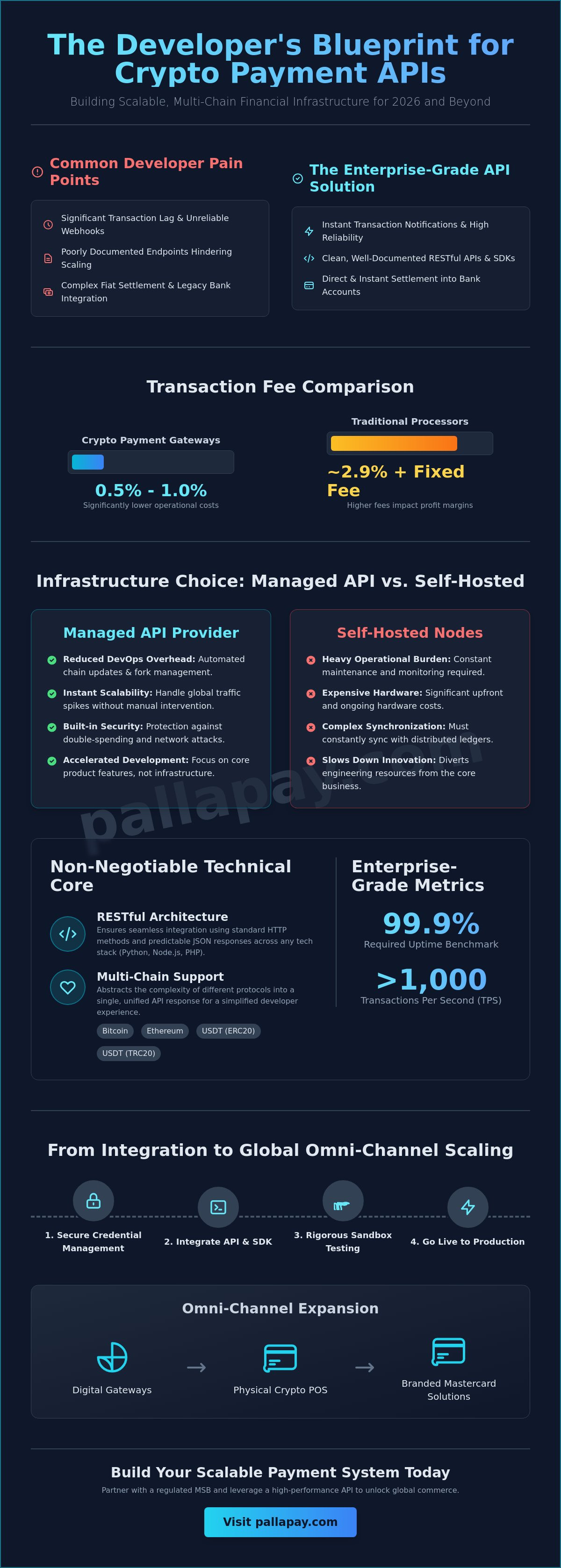
    In 2026, a crypto payment API for developers is no longer a peripheral experiment; it’s the essential bridge between decentralized liquidity and institutional financial stability. While transaction fees for crypto gateways now range between 0.5% and 1.0%, significantly lower than traditional processors, the real value lies in the reliability of the underlying infrastructure. You’ve likely faced the operational drag caused by unreliable webhooks, transaction lag, or the complexity of moving funds back into the legacy banking system. It’s frustrating when poorly documented endpoints prevent your application from scaling at the pace of global commerce.

    This comprehensive guide provides the technical framework you need to evaluate and integrate enterprise-grade solutions with absolute confidence. You’ll learn how to implement clean, well-documented RESTful APIs and SDKs that offer instant transaction notifications and direct settlement into bank accounts. We’ll also explore how to maintain compliance under the latest MiCA and GENIUS Act frameworks. By the end of this article, you’ll have a clear roadmap for building a scalable, multi-chain payment system that transforms complex technical conversions into standard, effortless business operations.

    Key Takeaways

    • Understand how the transition to Payments-as-a-Service models allows businesses to move beyond simple wallet transfers toward comprehensive financial infrastructure.
    • Learn to integrate a high-performance crypto payment api for developers that utilizes RESTful architecture to support Bitcoin, Ethereum, and multi-chain USDT transactions.
    • Discover the strategic advantage of partnering with a regulated MSB to ensure compliant crypto to bank transfers and instant fiat settlement.
    • Master the full integration lifecycle, from secure credential management in the merchant dashboard to rigorous sandbox testing for production-ready reliability.
    • Explore omni-channel scaling opportunities by connecting digital gateways with physical crypto POS machines and branded Mastercard solutions for real-world spending.

    The Role of Crypto Payment APIs in Modern Software Architecture

    The evolution of cryptocurrency has shifted from speculative trading to a foundational element of global commerce. In 2026, a crypto payment api for developers acts as a sophisticated “Payments-as-a-Service” layer within modern software architecture. This evolution moves far beyond simple wallet-to-wallet transfers. It integrates complex financial logic directly into the application stack. Developers no longer view blockchain as a separate entity but as a standard microservice that facilitates real-time value exchange with institutional reliability.

    Choosing managed API providers over self-hosted nodes is now the industry standard for high-growth companies. This transition eliminates the heavy operational burden of maintaining expensive hardware and constantly synchronizing distributed ledgers. Managed providers offer several critical advantages for the modern dev team:

    • Reduced DevOps overhead through automated chain updates and fork management.
    • Instant scalability to handle global traffic spikes without manual intervention.
    • Built-in security protocols that protect against double-spending and network-level attacks.

    By offloading these background processes to a specialized partner, engineering teams can focus on core product features. This strategic shift accelerates the development lifecycle and ensures that the financial infrastructure remains lean and efficient.

    Why 2026 is the Year of Institutional Crypto Integration

    Institutional adoption has reached a tipping point where digital assets are a standard checkout option. The demand for multi-currency support has surged as users look to spend both volatile assets and stablecoins like USDT. APIs serve as the essential bridge that facilitates cross-border commerce without the traditional friction of intermediary banks. This global reach is especially vital for industries like ecommerce where speed and low fees are competitive requirements. Using a crypto payment api for developers allows businesses to tap into these global markets while maintaining compliance with evolving regulations.

    Evaluating API Reliability and Uptime

    System availability is the most critical metric for any financial infrastructure. A 99.9% uptime benchmark is no longer optional; it’s a requirement for enterprise trust. Leading providers use redundant node clusters to ensure API responsiveness even during periods of heavy network congestion. You should verify that your provider can handle high-throughput scenarios, often exceeding 1,000 transactions per second. Reliable infrastructure ensures that every payment request is processed instantly. This consistency maintains the momentum of your business operations and prevents the loss of customer trust during the checkout process.

    Technical Core: RESTful Architecture and Multi-Chain Support

    Building a resilient financial application requires an architectural foundation that prioritizes predictability and interoperability. A modern crypto payment api for developers utilizes a RESTful structure to ensure that integration remains seamless across diverse tech stacks, whether you’re working with Python, Node.js, or PHP. This design choice allows for standard HTTP methods and JSON responses, making the integration process intuitive for engineering teams. By using a unified interface, you can manage complex blockchain interactions without needing to master the specific nuances of every underlying protocol.

    Multi-chain capability is a non-negotiable requirement in 2026. Your infrastructure must support a broad spectrum of assets, including Bitcoin, Ethereum, and stablecoins like USDT on both ERC20 and TRC20 networks. Abstracting the complexities of these different protocols into a single API response simplifies the developer experience. Accessing real-time exchange rates and network fee estimations through the same interface ensures that your users always see the most accurate pricing during the checkout flow. For those looking to implement these features immediately, exploring a professional API for crypto payments provides the necessary tools to get started.

    In financial processing, the concept of idempotency is vital. It ensures that if a request is sent multiple times due to a network timeout, the transaction is processed only once. This prevents the nightmare of duplicate charges or inconsistent database states. As global Cryptocurrency Regulation matures, maintaining these high standards of technical precision becomes both a legal and operational necessity. It builds a layer of trust that users expect from institutional-grade financial services.

    Webhook Management and Transaction Callbacks

    Reliable payment processing depends on secure, real-time communication between the gateway and your application. Implementing secure webhooks requires signature verification to prevent malicious spoofing attempts. Your system should also allow for custom threshold settings regarding network confirmations. This flexibility lets you decide when a payment reaches finality based on your specific risk tolerance. Automatic retry logic ensures that even if your server experiences a brief hiccup, you’ll never miss a successful payment notification.

    Security Protocols: Protecting the Developer Pipeline

    Protecting the developer pipeline is as important as securing the transactions themselves. Best practices involve environment-based access control, where sandbox and production environments use distinct API keys. You should implement IP whitelisting and role-based access for sensitive withdrawal endpoints to minimize the attack surface. End-to-end encryption for transaction metadata ensures that sensitive user information remains private. These layers of defense create a secure environment that allows for rapid innovation without compromising on safety.

    Crypto Payment API for Developers: Building Scalable Financial Infrastructure in 2026

    Strategic Differentiators: Compliance and Fiat Settlement

    Developers often struggle with the legal gray areas of digital asset management. A robust crypto payment api for developers solves this by prioritizing a “Compliance First” architecture. Registration as a Money Service Business (MSB) in the United States and Canada isn’t just a badge; it’s an operational guarantee. It ensures that every transaction processed through your application adheres to strict federal standards. This institutional reliability is what separates professional-grade infrastructure from experimental gateways. It allows you to offer your users the stability they require for high-volume commerce.

    Bridging the gap between non-crypto-native businesses and digital liquidity requires sophisticated conversion tools. Automated fiat settlement eliminates the volatility risks that often deter traditional merchants. Instead of holding volatile assets, businesses can receive funds directly in their local currency. This process is streamlined by integrated KYB (Know Your Business) protocols. These API-driven verification flows allow for rapid merchant onboarding while maintaining full regulatory integrity. It transforms what used to be a complex legal hurdle into a standard, automated background process.

    Direct Crypto-to-Bank Transfers

    Scaling a global enterprise requires efficient ways to manage payroll and vendor payments. Enabling crypto to bank transfers directly through an API allows for seamless off-ramping into major fiat currencies like USD, EUR, AED, and INR. While traditional systems often rely on T+3 settlement windows, modern infrastructure is pushing toward instant availability. This transition is essential for maintaining a healthy cash flow in fast-paced markets. It empowers developers to build applications that function as a professional bridge between diverse financial ecosystems.

    Navigating Global Regulations

    Operating across 180 countries requires a deep understanding of localized legal requirements. For example, the Oregon cryptocurrency payment law demonstrates how regional frameworks are beginning to define the scope of digital transactions. Pallapay handles these complexities for developers by embedding AML (Anti-Money Laundering) monitoring into every API transaction flow. This proactive approach ensures that your application remains compliant without requiring you to build an in-house legal department. Automated transaction exports also simplify tax reporting, providing a clean audit trail for every global operation.

    Developer Experience: Streamlining the Integration Lifecycle

    A sophisticated crypto payment api for developers must prioritize the developer experience as much as the transaction throughput. The integration lifecycle begins in the merchant dashboard where you generate your unique API keys. This centralized hub serves as your command center, providing immediate access to the credentials required for secure communication. Once keys are secured, the transition to the sandbox environment allows you to simulate both successful and failed transaction scenarios without risking real capital. It’s an essential safety net that ensures your logic is sound before moving to a live environment.

    Configuring webhook listeners is the next critical phase in building a real-time financial application. Instead of inefficient polling, webhooks provide instant notifications for order updates; this allows your system to react immediately to payment finality. You can then choose to customize the checkout UI to match your brand’s aesthetic or utilize pre-built payment widgets for a faster time-to-market. Monitoring transaction health in production completes the cycle, ensuring that your infrastructure remains performant as you scale. If you’re ready to begin your integration, you can access the developer portal to see these tools in action.

    Documentation and SDKs

    Clarity in documentation is the hallmark of a professional financial partner. We provide ready-to-use code snippets for Node.js, Python, and PHP to accelerate your development timeline. For instance, recent early 2026 updates to the Python Unified SDK v8.0.1 and PHP Unified SDK v10.1.2 ensure compatibility with the latest security standards. Using Swagger or OpenAPI specifications allows for automated client generation, reducing the likelihood of manual errors. Enterprise clients also benefit from dedicated integration managers who provide direct support throughout the deployment process.

    Customizing the User Journey

    Maintaining brand consistency is vital for building user trust during the payment process. White-labeling options allow you to keep the experience seamless, ensuring that the checkout flow feels like a natural extension of your platform. You can also generate flexible payment links for social media or email invoicing, providing a low-friction way for customers to settle balances. For businesses looking to expand their utility, integrating gift card issuance directly into the checkout flow adds a layer of versatility that traditional gateways often lack. This comprehensive approach ensures that every touchpoint is optimized for conversion and growth.

    The Pallapay Advantage: Building for Global Scale

    The definitive advantage of a crypto payment api for developers lies in its ability to transcend the digital screen and integrate with the physical world. While many providers stop at the checkout page, our ecosystem bridges the gap between digital asset processing and tangible commerce. By integrating with crypto POS machines, developers can build omni-channel solutions that unify online sales with retail storefronts. This holistic approach is further enhanced by the issuance of Pallapay Mastercards. These cards enable users to spend API-processed funds in the real world instantly. It’s a complete lifecycle that transforms digital liquidity into practical, everyday utility.

    Institutional operations often involve high-volume settlements that exceed standard gateway limits. Our OTC crypto exchange desks provide the necessary liquidity for these large-scale movements, ensuring that even the most significant transactions are handled with professional precision. This combination of high-throughput API access and institutional OTC support positions Pallapay as the definitive destination for 2026 crypto-fiat operations. It’s about providing the tools needed for global scale. We handle the complex background processes so you can focus on expansion.

    Omni-channel Payments for Retail and Hotels

    For industries such as hospitality, the division between booking and check-in often creates data silos. Modern hotels use the API to secure online reservations and then utilize physical POS terminals for on-site services. This unifies all transaction data into a single dashboard, providing a clear view of business health. This same infrastructure allows ecommerce platforms to scale rapidly, utilizing high-availability servers that handle global traffic without interruption. Efficiency is the priority. Your data remains synchronized across every touchpoint.

    The Future of the Pallapay Ecosystem

    The Pallapay roadmap includes expanding Layer 2 scaling support and deeper DeFi integrations to keep your application at the forefront of innovation. Security remains the cornerstone of our progress. We apply rigorous protection standards to the Pallapay wallet and the entire API infrastructure to safeguard institutional assets. The evolution of global finance is inevitable. It’s a shift toward a more integrated, efficient, and borderless system. You can start building with Pallapay today to ensure your business is part of that future.

    Empowering Global Commerce with Institutional-Grade Infrastructure

    The financial landscape of 2026 demands more than a simple gateway; it requires a resilient bridge between digital assets and traditional banking systems. By selecting a high-performance crypto payment api for developers, you gain access to a platform that prioritizes regulatory compliance and technical precision. We’ve detailed how MSB registration in the US and Canada provides the security foundation your enterprise needs to scale. You’ve also seen how RESTful architecture and instant fiat settlement options eliminate the operational friction typically associated with blockchain transactions.

    This infrastructure facilitates seamless operations across 180 countries, ensuring your application is ready for immediate global deployment. Whether you’re unifying online checkouts with physical POS machines or enabling real-world spending via integrated Mastercards, the tools for success are now at your fingertips. It’s time to transform complex background processes into standard business operations.

    Build Your Future with Pallapay: Get Your API Key

    The evolution of finance is happening now, and your business is ready to lead the way.

    Frequently Asked Questions

    What is a crypto payment API and how does it work for developers?

    A crypto payment API is a set of RESTful endpoints that allows software to interact with blockchain networks for automated payment processing. Developers use these tools to generate unique payment addresses, monitor incoming transactions in real time, and manage fund settlements. It abstracts the complexity of node maintenance and ledger synchronization into a single, reliable integration layer that connects directly to your application stack.

    Which cryptocurrencies can I accept through the Pallapay API?

    You can accept major digital assets including Bitcoin, Ethereum, and USDT across multiple network standards such as ERC20 and TRC20. The platform is engineered for broad utility, allowing your application to support the most liquid assets currently utilized in global commerce. This ensures your customers have the flexibility to pay with their preferred digital assets while you maintain a unified transaction record.

    How do I ensure the security of my crypto API integration?

    Security is maintained through environment-based API key management, IP whitelisting, and mandatory signature verification for all incoming webhooks. You should implement role-based access controls for sensitive withdrawal endpoints and utilize end-to-end encryption for all transaction metadata. These layers of defense prevent unauthorized access and ensure the absolute integrity of your financial data within the developer pipeline.

    Can I settle crypto payments directly into my local bank account?

    Yes, the system facilitates direct crypto to bank transfers into local accounts in major currencies like USD, EUR, GBP, and AED. This feature allows businesses to convert digital assets into fiat instantly, effectively bypassing the volatility often associated with holding cryptocurrencies. It creates a professional bridge between modern digital payments and your established local financial institutions for seamless cash flow management.

    What are the transaction fees for using a professional crypto payment gateway API?

    Industry transaction fees for professional gateways typically range between 0.5% and 1.0%, which is significantly lower than traditional credit card processors. While specific costs depend on your transaction volume, using a crypto payment api for developers reduces the overhead associated with intermediary banks. You can monitor your specific settlement costs through the merchant dashboard to maintain full transparency over your operational expenses.

    Does Pallapay support stablecoins like USDT and USDC for business payments?

    Pallapay provides extensive support for USDT on various chains to facilitate stable, low-volatility business transactions for global merchants. Stablecoins are essential for businesses that require price certainty during the settlement process. The platform ensures these assets are processed with high-speed reliability, making them ideal for high-volume operations such as global payroll or vendor payments without the risk of market fluctuations.

    How does webhook notification work in a crypto payment flow?

    Webhooks function as automated callbacks that send real-time data from the gateway to your server when a transaction status changes. When a payment is detected or reaches the required confirmation threshold on the blockchain, the API pushes a POST request to your listener. This eliminates the need for inefficient manual polling and ensures your application reacts instantly to provide a smooth customer experience.

    Is MSB registration necessary for companies providing crypto payment APIs?

    MSB registration is a critical legal requirement for providers operating in regions like the US and Canada to ensure AML and KYC compliance. It signifies that the provider is a regulated financial entity, offering institutional trust and legal protection for the developers using their infrastructure. Partnering with a registered MSB is essential for maintaining a compliant, high-volume operation that meets global financial standards.

    Disclaimer

    The information provided on this website and blog is for general informational and educational purposes only and does not constitute financial, investment, legal, tax, or other professional advice.
    Cryptocurrency and digital asset services may be subject to regulatory restrictions in certain jurisdictions. Users are solely responsible for ensuring compliance with applicable local laws and regulations before using any products or services mentioned on this website.
    PallaPay does not guarantee the accuracy, completeness, or timeliness of any information published and accepts no liability for any loss or damages arising from reliance on the content. Any opinions expressed are those of the respective authors and may change without notice.
    Certain services, features, or products referenced may be provided through third-party partners, licensed entities, or affiliated service providers subject to separate terms and regulatory approvals. Availability of services may vary by country or region.
    This website may contain references to digital assets, virtual currencies, or blockchain-related services that are not available to residents of certain jurisdictions, including where prohibited by law. Nothing on this website constitutes an offer, solicitation, or recommendation to buy or sell any financial instrument or virtual asset.