
A crypto payment business may need both virtual-asset authorization and payment-service approval, depending on what it does. UAE crypto payment regulations distinguish between these activities: the Central Bank oversees payment-token services, while the authority responsible for virtual-asset authorization depends on the activity and regulatory jurisdiction. The key question is whether a business is simply accepting crypto or providing a regulated service involving it.
That distinction is easy to miss. A company that handles customer assets, facilitates transactions, or provides payment services may face different licensing and compliance obligations from a merchant accepting crypto for its own sales.
This guide explains who may need a UAE crypto license, how the main authorities divide oversight, and what non-compliance can mean. It also outlines when Central Bank rules may apply to fiat-to-crypto and payment-token services, so businesses can identify the regulatory questions raised by their operating model.
Key Takeaways
- Identify whether your business activity involves virtual assets, payment tokens, or both, since the service you provide shapes its licensing obligations.
- Understand how federal oversight and regulators in financial free zones divide responsibility for crypto-related activities.
- See why fiat-to-crypto services can bring Central Bank payment and operational requirements into scope.
- Learn how licensing breaches and failures to meet compliance duties can lead to enforcement action.
- Explore how a crypto debit card or payment infrastructure may fit into a compliant business model.
Federal regulation of virtual assets and service providers under UAE crypto payment regulations
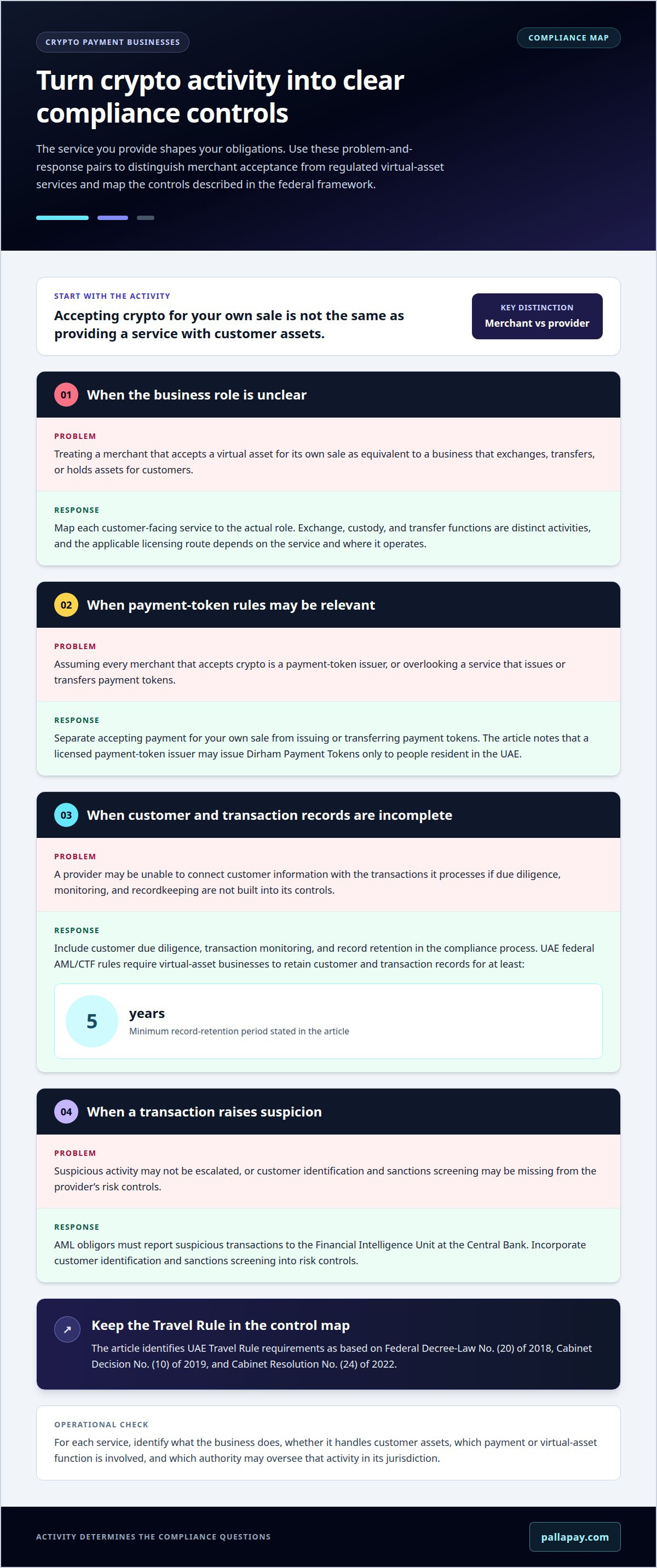
Federal rules cover virtual-asset services, payment tokens, and related compliance duties. A business’s obligations depend on what it does: accepting payment is different from exchanging, transferring, or holding virtual assets for customers.
Cabinet Decision No. 111 of 2022 provides a federal framework for virtual assets and their service providers. Since 2022, virtual asset activities in onshore UAE have required an SCA license or approval from a local regulator. The applicable authority depends on the service and where the business operates.
Virtual Asset Framework
The UAE virtual-asset framework regulates service providers according to their activities and jurisdiction. Corporate registration alone does not authorize a company to provide every virtual-asset service.
An exchange, custodian, and transfer provider perform distinct functions, so each should map its customer services to the relevant licensing requirements. Cabinet Resolution No. 112/2022 delegated certain virtual-asset regulatory competencies to the Securities and Commodities Authority. Businesses should identify the competent authority before implementing a new service or changing an existing one.
Crypto Payments and Price Display
Payment-token rules cover defined payment services and issuance activities. They do not make every merchant a payment-token issuer. This distinction matters when deciding how to accept crypto and display prices.
A merchant accepting a virtual asset for its own sale has a different role from a provider that issues or transfers payment tokens. A licensed payment-token issuer may issue Dirham Payment Tokens only to people resident in the UAE. These rules do not require all businesses to advertise prices in cryptocurrency or UAE dirhams.
Provider Compliance Obligations
Compliance duties include customer due diligence, transaction monitoring, record retention, and suspicious-transaction reporting. These controls help providers connect customer information with the transactions they process.
UAE federal AML/CTF rules require virtual-asset businesses to retain customer and transaction records for at least 5 years. AML obligors must report suspicious transactions to the Financial Intelligence Unit at the Central Bank. The UAE Travel Rule requirements are based on Federal Decree-Law No. (20) of 2018, Cabinet Decision No. (10) of 2019, and Cabinet Resolution No. (24) of 2022. Providers should incorporate customer identification and sanctions screening into their risk controls.
Who regulates crypto in the UAE?
Crypto oversight in the UAE is divided by activity and jurisdiction, so a business may need to consider more than one authority. The main distinction is between virtual-asset activity, payment services, and financial services conducted within a financial free zone.
Regulatory Roles Across the UAE
The Central Bank of the UAE oversees payment-related services within its remit, while the federal securities regulator and financial free-zone authorities supervise other activities. A crypto business’s service model determines which rules may apply.
The Capital Market Authority replaced the Securities and Commodities Authority in January 2026. The Central Bank issued guidance in May 2023 for financial institutions conducting due diligence on virtual-asset service providers. In ADGM, the Financial Services Regulatory Authority supervises firms conducting virtual-asset-related business. Each authority’s role turns on the activity and regulatory perimeter, not simply the technology a business uses.
Rules Across Mainland and Free Zones
Mainland jurisdictions, commercial free zones, and financial free zones have distinct regulatory structures. Registration in a free zone does not, by itself, authorize regulated financial activity across the UAE.
For a business operating in several emirates, the relevant licensing route may depend on where each service is conducted. Separate virtual-asset services from payment services, then identify the authority responsible for each activity. ADGM, for example, has its own financial-services regulator and digital-asset framework. Free-zone status and foreign ownership are separate from permission to conduct regulated services.
ADGM and Financial Services Oversight
ADGM applies a dedicated framework to financial services involving virtual assets. Firms that exchange, arrange, or safeguard digital assets within its jurisdiction need to consider the local regulator’s requirements.
The Financial Services Regulatory Authority launched its digital-asset framework in 2018. Firms wishing to conduct virtual-asset-related business in ADGM must obtain the necessary licenses from the FSRA. The framework provides a jurisdiction-specific route, rather than a universal authorization for activities throughout the UAE.
The DFSA independently oversees virtual-asset activities within its financial-services jurisdiction. The Central Bank’s payment remit and financial-zone regulators’ responsibilities may intersect when a service combines token activity with payment functions. Map each service, customer flow, and operating location to the relevant regulator before setting policies or planning a launch.
DFSA plans for a crypto-regulatory framework
The DFSA announced plans for a comprehensive crypto-regulatory framework in January 2021. Its approach has since changed: on January 12, 2026, it overhauled the DIFC Crypto Token Regulatory Framework. The changes replaced a pre-approved token list with a firm-led suitability model. For businesses, this makes the firm’s assessment of a token central to how it applies the framework.
Under the earlier model, a pre-approved list provided a central reference for token recognition. The January 2026 change moved away from that method. A firm-led suitability model places the assessment at the firm level, so businesses need to understand how each token fits their activities and services. The regulatory change concerns the DFSA framework, not a general rule for every UAE jurisdiction.
The DFSA’s three-month transition period for reviewing recognized crypto tokens ended April 12, 2026. That period gave firms time to assess tokens under the revised approach before the transition ended. The date is operationally relevant: a company planning token-related services should account for the current firm-led model, rather than treating the former list as the ongoing framework.
For a practical assessment, map each token to the activity it supports. A token used in a trading service, for example, may raise different suitability considerations from one used in a payment flow. The DFSA framework assigns suitability assessment to firms, which should consider the token, its use, and the proposed service. This ties decisions to actual operations.
Licensing is a separate question from token suitability. The DFSA oversees virtual-asset activities in the DIFC, and firms providing financial services in relation to virtual assets must obtain the appropriate DFSA license. Assessing a token does not authorize a business to conduct a regulated activity. Firms should consider both the token framework and the license required for their services.
The January 2026 framework therefore changes how firms approach token recognition, while the licensing requirement addresses permission to provide covered financial services. A business can organize its review by identifying each token, documenting its intended use, and connecting that use to its regulated activity. It can then assess whether the activity requires DFSA authorization. These are distinct regulatory questions, and addressing them separately clarifies the firm’s obligations.
Penalties for crypto-business non-compliance
For a UAE crypto business, non-compliance can put its authorization and continuity at risk. A virtual-asset regulator may impose fines or suspensions, or revoke a license after determining that a violation occurred. Consequences depend on the jurisdiction, regulated activity, and breach. An exchange, for example, faces different operational exposure from a merchant accepting crypto without providing virtual-asset services.
AML failures can create specific enforcement exposure. UAE rules require virtual-asset businesses to retain customer and transaction records for at least 5 years. Suspicious transactions must be reported to the Financial Intelligence Unit at the Central Bank. Missing records, weak monitoring, or a failure to report can undermine a firm’s ability to demonstrate compliance when its activity is reviewed.
Tax treatment is separate from licensing. The UAE applies a 9% corporate tax to business profits exceeding AED 375,000. Individuals are not subject to personal income tax on cryptocurrency trading or holdings, while businesses still need to account for corporate tax on qualifying profits.
VAT treatment also has a defined scope. VAT on UAE virtual-currency transfers, exchanges, and conversions was eliminated as of October 2024. That change concerns those crypto transactions; it does not erase a business’s other tax or regulatory duties. For example, a crypto exchange must consider its licensing and AML controls separately from the VAT treatment of a conversion.
For a corporate compliance review, separate the risks by obligation. First, map each service to its relevant jurisdiction and authorization. Then test customer identification, sanctions screening, transaction monitoring, reporting, and record retention against the firm’s actual activity. The UAE Travel Rule requirements are based on Federal Decree-Law No. (20) of 2018, Cabinet Decision No. (10) of 2019, and Cabinet Resolution No. (24) of 2022.
A breach can affect more than a company’s relationship with its regulator. A suspension or revoked license can prevent the business from continuing the regulated activity, while deficient records can complicate transaction investigations. Keep clear documentation that connects customer files, transfer records, and suspicious-activity reports to the compliance process.
Non-compliance has two distinct financial dimensions: regulatory enforcement and tax obligations. Treating tax calculation as a substitute for regulatory compliance leaves separate risks unaddressed.
Central Bank oversight of fiat-to-crypto services
The Central Bank of the UAE oversees payment-token services, adding a distinct layer to crypto compliance. Its Stored Value Facilities regulation dates to 2020 and covers payment services involving virtual currencies. That framework matters when a business connects customer funds, payment tokens, and fiat transactions. A crypto transfer service and a payment-token issuer can therefore raise different regulatory questions.
The Central Bank’s rules on payment tokens and stablecoins depend on the token’s regulatory classification and the service performed. A licensed payment-token issuer may issue Dirham Payment Tokens only to people resident in the UAE. A bank cannot itself act as a Payment Token Issuer, but may establish a subsidiary, affiliate, or related entity, subject to licensing and other requirements.
Issuance is only one regulated function. A tokenholder may request redemption of a Payment Token without a time limit, which makes redemption procedures central to an issuer’s operating model. If a material misstatement in a published White Paper causes qualifying loss or damage, the issuer must compensate the customer within at least 28 calendar days.
Operational controls matter, too. Payment Token Service Providers must report major security and operational incidents, including downtime, to the Central Bank immediately or as directed. Link the incident process to payment operations so teams can identify a qualifying event, escalate it, and report it without delay.
The regulation also sets a specific transition mechanism. For one calendar year following the commencement of the Payment Token Services Regulation, Article (2) does not apply. After the transition period ends, the Retail Payment Services and Card Schemes Regulation no longer applies to crypto-assets, virtual asset tokens, virtual asset service providers, or virtual asset token services.
The Central Bank’s role is especially relevant when payment flows involve fiat conversion, token issuance, redemption, or stored-value functions. Separate these activities in the service design. For example, a business facilitating an exchange may need to assess its virtual-asset obligations separately from those of a related payment-token service.
Data handling is another part of the framework. Licensed Payment Token Service Providers must process and retain only the personal data needed to provide their services, and must first obtain the customer’s explicit consent. This affects onboarding and transaction processes: define what information each service needs and limit collection accordingly.
The practical takeaway is to map each transaction from the customer’s instruction through conversion, token movement, and settlement. This helps identify whether the activity involves a payment token, a stored-value service, or another virtual-asset function. Then assess the Central Bank’s incident, licensing, redemption, and data rules against the specific service, rather than treating every crypto transaction as identical.
Best Crypto Debit Cards 2026: Visa & Mastercard Compared: crypto debit card
Best Crypto Debit Cards 2026: Visa & Mastercard Compared helps readers assess card options after understanding the rules for crypto-related services. A crypto debit card suits people looking to spend from a crypto balance, while merchants considering payment acceptance may need a different setup.
For merchant payment flows, Pallapay’s Crypto Payment Gateway or Crypto Payment API can connect crypto payments with business systems. Individuals looking to convert Bitcoin to cash can use Pallapay’s Sell Bitcoin for Cash service. Match the option to the need: spending, accepting, or converting assets.
If you’re ready to discuss which of these options fits your use case, contact Best Crypto Debit Cards 2026: Visa & Mastercard Compared.
Build your next step around the service you plan to deliver
Turn your regulatory review into a practical operating decision. First, define the customer journey: will people spend crypto, convert it, or use a payment service? Then align the product flow, customer information, and transaction handling with that purpose. Clarifying the service before choosing technology makes the next business decision more focused.
For individuals, a Pallapay Crypto Card may suit everyday spending from a crypto balance. For a business, payment infrastructure may be more relevant. The right option depends on the function you want to support and how it fits your obligations under UAE crypto payment regulations.
When you’re ready to explore a crypto card or cash conversion option, contact Best Crypto Debit Cards 2026: Visa & Mastercard Compared to discuss your next step. A clear service goal gives you a stronger starting point for moving forward with confidence.
Frequently Asked Questions
Who needs a crypto license in the UAE?
A business is more likely to need authorization when it provides crypto services for customers, rather than accepting an asset solely for its own sale. A platform that exchanges tokens or controls customer assets, for example, has a different role from a shop receiving payment for a product. Review the customer journey, including who controls the assets and initiates transfers, to clarify the business’s regulatory position.
Which UAE authorities regulate cryptocurrency payments, and what are their jurisdictions?
The Central Bank of the UAE oversees relevant payment services, while the Capital Market Authority handles federal securities oversight. The DFSA and the FSRA supervise financial services within their respective financial free zones. Focus on the service performed: payment functions, securities activity, and financial services can raise different regulatory considerations, even when they use the same blockchain technology.
Are businesses in the UAE allowed to accept cryptocurrency as payment?
Businesses can consider accepting crypto for their own sales, but this is different from providing exchange, custody, or transfer services to customers. A merchant checkout that receives payment, for example, differs from a platform that holds customer tokens before converting them. Before launch, define how prices appear to customers, how payment confirmation works, and how the merchant records each transaction.
What licensing is required to provide crypto payment services in the UAE?
The required authorization depends on the precise functions in the payment flow, not simply on calling a business a payment provider. A service might receive tokens, convert them, hold them temporarily, or transfer them onward. Document which entity performs each function and controls the assets. This helps ensure that a technology or processing arrangement does not obscure the regulated activities the business actually performs.
How do local virtual-asset rules affect crypto payments?
Local rules can affect which authorization applies to a provider’s virtual-asset activity and where it may operate. A merchant’s own checkout is not the same model as a third-party service that exchanges or safeguards tokens. Define the service boundary in customer terms, contracts, and system design so the operational role is clear, rather than relying on a product label.
What penalties or enforcement actions apply for unlicensed crypto payment services in the UAE?
Enforcement can include financial penalties, suspension, or loss of authorization, depending on the regulator and the breach. Preserve records showing how the service operated, who approved transactions, and how customer assets were handled. If a control failure occurs, document the affected process and corrective actions. Clear operational records help explain the company’s response during regulatory scrutiny.
What steps must a UAE business take to accept crypto payments legally?
Design the customer experience before activating a crypto checkout. Specify how prices are displayed, when an order counts as paid, how failed or delayed transfers are handled, and how refunds are communicated. Then align invoices and transaction reconciliation with that flow. These decisions support consistent customer treatment and help identify whether the model goes beyond accepting payment for the business’s own goods or services.
How do VARA rules apply to crypto payments in Dubai?
In Dubai outside the DIFC, a virtual asset service provider must obtain a VARA license before operating. A merchant accepting crypto for its own sale has a different role from a provider that exchanges, transfers, or holds virtual assets for customers. Payment services may also fall under Central Bank oversight.
Disclaimer
The information provided on this website and blog is for general informational and educational purposes only and does not constitute financial, investment, legal, tax, or other professional advice.
Cryptocurrency and digital asset services may be subject to regulatory restrictions in certain jurisdictions. Users are solely responsible for ensuring compliance with applicable local laws and regulations before using any products or services mentioned on this website.
PallaPay does not guarantee the accuracy, completeness, or timeliness of any information published and accepts no liability for any loss or damages arising from reliance on the content. Any opinions expressed are those of the respective authors and may change without notice.
Certain services, features, or products referenced may be provided through third-party partners, licensed entities, or affiliated service providers subject to separate terms and regulatory approvals. Availability of services may vary by country or region.
This website may contain references to digital assets, virtual currencies, or blockchain-related services that are not available to residents of certain jurisdictions, including where prohibited by law. Nothing on this website constitutes an offer, solicitation, or recommendation to buy or sell any financial instrument or virtual asset.