

The crypto card with the biggest cashback rate may not deliver the best real-world return. Spending caps, eligibility rules, token requirements, and fees can reduce what you actually earn. To compare the highest cashback crypto cards fairly, look beyond their advertised percentages.
Start with the rate, but also consider how you qualify, which purchases count, how rewards are paid, and whether card costs outweigh your earnings.
This guide compares cashback terms with fees, limits, networks, and everyday usability. It also distinguishes debit cards, which spend from an available balance, prepaid cards, which use funds loaded in advance, and credit cards, which provide access to a credit line.
For readers who prioritize spending utility over rewards, the Pallapay Crypto Card is available in virtual and physical formats on Visa or Mastercard networks. It supports online and contactless payments, as well as Chip and PIN. The comparisons ahead explain when a reward-led card makes sense and when practical crypto-spending features matter more.
Key Takeaways
- Compare the highest cashback crypto cards by qualifying purchases, reward caps, and eligibility, not headline rates alone.
- Understand how each card calculates, credits, and lets you redeem rewards before estimating potential earnings.
- Weigh documented fees and exclusions against your own spending patterns using the same comparison method for each card.
- Distinguish debit, prepaid, and credit card mechanics to identify which funding model fits your everyday use.
- Decide whether rewards or practical crypto-spending features matter more for your wallet.
What Makes the Highest Cashback Crypto Cards Different from the Best-Value Cards?
The highest advertised cashback rate is not automatically the best usable reward. A card may reserve its top rate for selected purchases, require a paid membership or token stake, or limit the spending that qualifies. The best-value card is the one whose rewards match your actual purchases and remain worthwhile after conditions and applicable fees.
Cashback is a reward for eligible card purchases, but its form matters. A discount lowers the purchase price directly, while points accumulate for later redemption under a program’s rules. Token incentives may reward actions such as staking or referring users rather than everyday purchases, so don’t treat every crypto-denominated benefit as purchase cashback.
Compare the full terms, not just the headline percentage. Consider which transactions qualify, whether monthly or category caps apply, which purchases are excluded, and how fees affect the net reward. Rankings can change with provider terms, eligibility, and spending patterns. A card that rewards frequent dining purchases may offer little value to someone whose spending falls outside its qualifying categories.
- Rate: Is the advertised maximum available on ordinary eligible purchases, or only in specific circumstances?
- Reward: Is it credited as cryptocurrency, a stablecoin, points, or another benefit?
- Conditions: Do caps, exclusions, membership requirements, or staking affect how much you can earn?
What does highest cashback mean on a crypto card?
“Highest” may refer to a maximum promotional or tiered rate, not the base rate for routine purchases. A provider may reserve its top tier for selected categories or account conditions, while other eligible spending earns less. Rewards can arrive as crypto, stablecoins, points, or another form, each with its own redemption terms and potential changes in value. Compare the rate, qualification rules, cap, and reward type together.
Is a crypto cashback card debit, credit, or prepaid?
Keep the comparison grounded in your own use. Start with purchases you make regularly, then assess the rate that applies to them and the form in which rewards arrive. This helps distinguish a striking advertised percentage from a benefit you can realistically use.
How Crypto Card Cashback Works: Rates, Tiers, and Reward Conditions
Crypto card cashback usually follows a sequence: a purchase is authorized, the provider determines whether it qualifies, the reward is calculated under the card’s rules, and the amount is credited for redemption or retention. The highest cashback crypto cards can still deliver different results because their tiers, caps, payout assets, and transaction rules vary.
Start with the reward calculation. A provider may calculate rewards on eligible purchase amounts, while excluded transactions earn nothing. The terms also define when rewards post, whether a purchase must settle first, and whether rewards are credited automatically or require a separate step. Authorization alone does not mean a reward has been earned.
Which purchases qualify for crypto cashback?
Each provider defines eligible purchases and exclusions. Online and in-store purchases may be treated differently from ATM withdrawals, recurring payments, or transactions classified under excluded merchant categories. For example, renting everyday household goods or gear on platforms like Life4Rent may be classified differently from traditional retail checkouts. Merchant classification matters: a purchase that appears to fit a reward category may be processed under a different category, while cash-like transactions may be excluded. Before estimating earnings, identify where you spend most and compare those purchases with the card’s eligibility rules.
How do reward caps, tiers, and payout assets affect value?
Tiers may depend on spending volume, membership, or other account conditions. A cap limits how much spending or how many rewards qualify during a set period. Examples cited in the article include ether.fi Core at 3% on the first $2,000 of monthly spending, and MEXC tiers of 4%, 6%, and 10%, with monthly reward caps of 100, 300, and 800 USDT respectively. These rates and caps are tied to their stated conditions, so they do not represent a guaranteed return for every cardholder.
Reward form changes the result. Stablecoin rewards are designed to track a stable value, while rewards paid in volatile crypto can rise or fall in value after crediting. Points may require redemption under separate rules. Account for whether redemption involves holding the asset, converting it, or meeting another condition, as well as any documented conversion costs.
Fees can also reduce the effective return. Consider transaction, foreign exchange, or crypto conversion charges where they apply, and account for how the card handles currency conversion on your purchases. Avoid subtracting a generic industry estimate from a reward rate. Use the specific terms that apply to the card and transaction.
- Confirm eligibility: Identify qualifying purchases, excluded merchant categories, and restricted transaction types.
- Map the limits: Note rate tiers, thresholds, caps, and the period over which they apply.
- Value the payout: Consider the reward asset, crediting process, redemption rules, and documented conversion costs.
For a broader view of how crypto assets fit into spending, explore crypto wallet options alongside card reward terms.
Highest Cashback Crypto Cards Compared: Rates, Networks, and Conditions
A useful comparison separates reward rates from network, fees, and eligibility. The examples below show reported cashback terms alongside Pallapay’s confirmed card features. Pallapay is included as a crypto-spending option, not ranked by cashback, so the comparison does not treat payment functionality as a reward.
How to read a crypto cashback card comparison table
Compare like with like: identify whether a published rate is a base rate, tier, maximum, or limited-time offer, and note whether the reward is paid in cash, a stablecoin, another token, or points. Eligibility, spending caps, exclusions, and fees all affect the value of a headline rate. The table distinguishes available rate details from card features, rather than treating unlike benefits as equivalent.
| Provider | Card type | Network | Cashback terms | Fees | Eligibility | KYC requirements | Source date |
|---|---|---|---|---|---|---|---|
| Pallapay | Crypto card | Visa or Mastercard | Spending features, not ranked by cashback | See applicable card terms | See applicable card terms | See applicable card terms | Current product information |
| ether.fi Core | Crypto card | Not stated in the rate example | Reported at 3% on the first $2,000 of monthly spending | Not stated in the rate example | Rate applies to stated spending limit | Not stated in the rate example | Rate example cited in article |
| MEXC | Crypto card | Not stated in the rate example | Reported tiers of 4%, 6%, and 10%, with monthly reward caps of 100, 300, and 800 USDT | Not stated in the rate example | Tier and monthly cap conditions apply | Not stated in the rate example | Rate example cited in article |
These examples illustrate why rates need context. A maximum tier, monthly cap, or qualifying-spend limit can change how much a cardholder actually receives. Compare the stated reward conditions with your spending, then weigh the result against the card’s payment features and applicable costs.
Where Pallapay Crypto Card fits in a rewards comparison
Pallapay belongs in a practical-spending comparison, not a cashback ranking. Its Crypto Card is available in virtual and physical formats on Visa or Mastercard networks. It supports online and contactless payments, Chip and PIN, and ATM withdrawals at supported ATMs. Eligible cards support Apple Pay, Google Pay, and Samsung Pay. These features help assess payment utility without implying a reward rate.
Use cashback terms to evaluate reward-led cards, then consider whether spending functionality matters more for your needs. Pallapay’s Crypto Card is an option for crypto-funded spending when card format and payment methods are central to the decision.
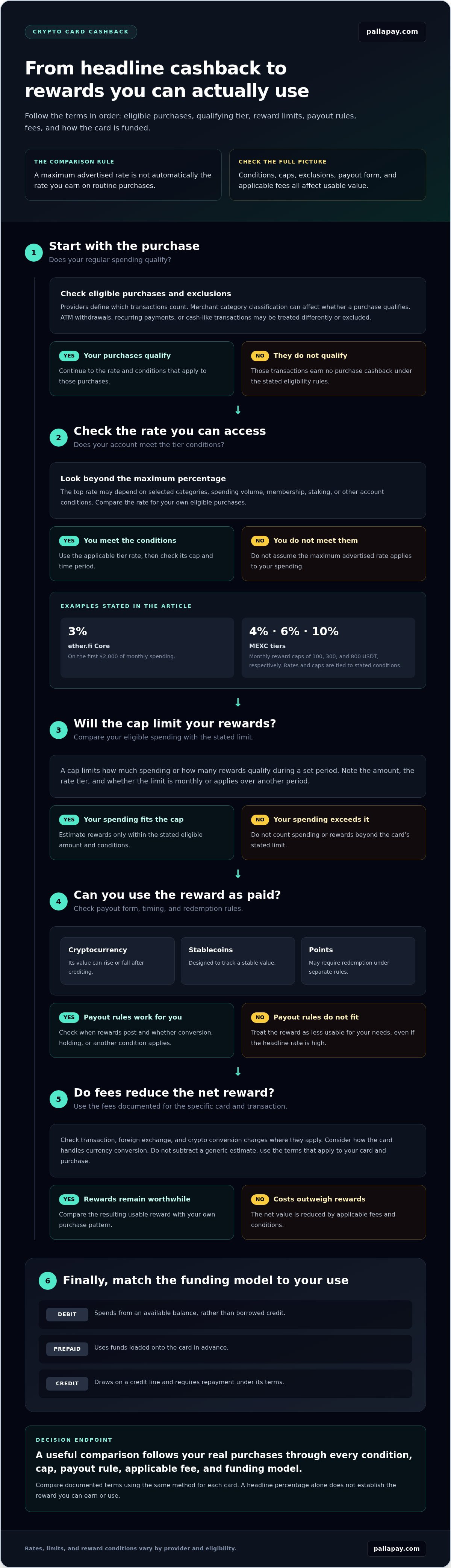
How to Compare Crypto Cashback Cards by Net Value and Everyday Fit
Use the same method for every card: start with your real spending, identify qualifying purchases, calculate rewards after documented costs, then assess whether the card works for your payment needs. This keeps the highest cashback crypto cards from winning on a headline rate that doesn’t match your everyday use.
- Map your spending. Review typical purchases by category and payment type, such as online orders, in-store purchases, subscriptions, or cash withdrawals. Use your actual spending mix rather than an imagined month designed to reach a reward tier.
- Assess eligibility. Establish whether the card is available to you and whether your usual transactions qualify. The issuer’s terms define category restrictions, spending thresholds, exclusions, and reward caps.
- Calculate net rewards. Multiply eligible spending by the rate that applies, then subtract documented card, conversion, foreign transaction, or ATM fees relevant to your use. Apply redemption conditions too. If a fee or reward rule is not provided, mark it as unknown rather than estimating.
- Assess everyday fit. Compare funding assets, card format, payment methods, network, and the way purchases settle. A higher theoretical return may not suit your routine if the card doesn’t support how you plan to pay.
Which card suits your spending and crypto balance?
Match reward categories to purchases you already make, then consider whether the card supports the assets you intend to use. Issuer information should explain whether the card uses an available balance or another funding arrangement and which payment methods it supports. Choose a virtual or physical format based on where you expect to pay, and account for the terms that apply to your intended use.
Keep the calculation specific to your own spending. For each card, record eligible purchases, the rate applied, any cap reached, and documented costs. That provides a fair comparison without assuming that a promotional rate applies to every purchase or that every reward asset has the same value.
How to assess fees, networks, and security controls
Review practical controls as part of usability, not as a substitute for reward analysis. Issuer-documented features such as transaction notifications and in-app card controls can affect how a card fits your routine. Pallapay’s card information includes real-time notifications and in-app controls. For a connected view of supported crypto assets, review crypto wallet options.
Choose a Crypto Card for Real Spending, Not Just the Highest Cashback
Choose a card based on how you spend and access crypto, not only its advertised reward ceiling. The highest cashback crypto cards may suit users whose regular purchases meet the stated reward terms. A practical crypto-spending card may be a better fit when payment methods, supported assets, and card format matter more.
When a cashback-first card makes sense
A reward-led card can make sense when your routine spending matches its eligible categories and you can meet its conditions without changing your habits. Consider the applicable rate, cap, exclusions, payout asset, and documented fees. A headline percentage alone can’t show how much value you’ll receive after limits and redemption requirements.
Reassess your choice when provider terms, your spending mix, or your eligibility changes. A card that once matched your purchases may become less useful if reward tiers change or your transactions no longer qualify. Keep a simple record of eligible spending and the benefits you actually receive, then compare that outcome with your everyday needs.
When crypto-spending utility matters more than rewards
For spending utility, consider how you want to access the card and which assets you use. The Pallapay Crypto Card is available in virtual and physical formats on Visa or Mastercard networks. It supports online and contactless payments, Chip and PIN, and ATM withdrawals at supported ATMs. Eligible cards support Apple Pay, Google Pay, and Samsung Pay. These are usability features, not cashback claims.
Supported assets include USDT, USDC, BTC, ETH, and additional listed cryptocurrencies. Review Pallapay wallet services when considering how supported crypto balances fit into your spending setup. Choose the virtual format for online use or the physical format when you prefer a card for in-person payments. The card also supports real-time transaction notifications and in-app card controls.
Before selecting a card, weigh these practical factors alongside any rewards:
- Spending pattern: Does your actual purchase mix qualify for the rewards you expect?
- Funding fit: Does the card support the assets and funding approach you plan to use?
- Payment access: Do its virtual or physical format and payment features suit your routine?
- Net value: Do the rewards remain worthwhile after applicable fees, caps, and redemption terms?
If crypto-spending utility is your priority, Explore the Pallapay Crypto Card and compare its confirmed payment features with the way you plan to pay.
Put Your Crypto Card Choice to Work
Make your choice a practical test. Track how the card fits your regular payments, whether its features support the way you spend, and whether its benefits still match your priorities. Revisit the decision when your spending habits or a provider’s terms change. This keeps reward expectations grounded in actual use rather than a headline rate that may not suit your circumstances.
If your priority is crypto-spending utility, Pallapay offers virtual and physical card formats on Visa or Mastercard networks. Confirmed features include online and contactless payments, Chip and PIN, ATM withdrawals at supported ATMs, real-time transaction notifications, and in-app card controls. Eligible cards also support Apple Pay, Google Pay, and Samsung Pay. Consider these features alongside the highest cashback crypto cards you’ve compared, without assuming every card serves the same purpose.
Choose the option that fits your day-to-day needs. Explore the Pallapay Crypto Card and see how its payment features align with your spending routine and your search for the highest cashback crypto cards.
Frequently Asked Questions
Which crypto card has the highest cashback in 2026?
The examples cited here report MEXC tiers of up to 10% cashback paid in USDT, with tier-specific monthly reward caps. That does not establish the best return for every cardholder: the qualifying tier and spending conditions affect the amount earned. Eligibility and whether typical purchases count also shape the outcome.
How does cashback work on a crypto debit card?
A crypto debit card provider reviews a transaction against its reward rules, then calculates and credits any cashback the purchase qualifies for. For example, a grocery purchase may earn rewards only if that merchant category is eligible and the cardholder meets applicable account conditions. The payout might be a crypto asset, stablecoin, fiat, or points. The provider’s terms define qualifying transactions, calculation rules, crediting timing, and redemption steps.
Are crypto cashback rewards paid in cash or cryptocurrency?
It depends on the issuer and card program. Some rewards may be credited in fiat, while others use stablecoins, volatile crypto tokens, or points with separate redemption rules. A stablecoin is designed to track a stable value, but it is still a digital asset. A volatile token’s market value can move after payout. Consider the reward denomination and redemption terms before treating rewards as cash-equivalent.
Do crypto cards charge fees that reduce cashback value?
They can, depending on the card’s terms and how you use it. Possible charges include card maintenance or issuance fees, purchase transaction charges, foreign transaction fees, ATM withdrawal fees, and crypto conversion costs. For example, a card used abroad may incur a different cost than one used for local purchases. Include issuer-documented fees that apply to your spending when estimating net rewards.
Can I use a crypto cashback card anywhere Visa or Mastercard is accepted?
Not necessarily. Visa or Mastercard branding does not guarantee that every card works at every merchant or in every country. Acceptance depends on the issuer’s supported regions, card terms, merchant acceptance, and transaction type. Currency handling and conversion may also affect a purchase.
Is a crypto debit card different from a crypto credit card?
Yes. A crypto debit card uses an available balance to fund spending, so purchases aren’t borrowing from a credit line. A crypto credit card lets the cardholder borrow up to an approved limit and creates a repayment obligation under the issuer’s terms. A crypto connection does not make debit and credit mechanics interchangeable.
Does Pallapay Crypto Card offer cashback rewards?
Pallapay’s Crypto Card information describes spending features rather than a cashback rate. The card is available in virtual and physical formats on Visa or Mastercard networks. Confirmed features include online and contactless payments, Chip and PIN, ATM withdrawals at supported ATMs, real-time transaction notifications, and in-app card controls.
Disclaimer
The information provided on this website and blog is for general informational and educational purposes only and does not constitute financial, investment, legal, tax, or other professional advice.
Cryptocurrency and digital asset services may be subject to regulatory restrictions in certain jurisdictions. Users are solely responsible for ensuring compliance with applicable local laws and regulations before using any products or services mentioned on this website.
PallaPay does not guarantee the accuracy, completeness, or timeliness of any information published and accepts no liability for any loss or damages arising from reliance on the content. Any opinions expressed are those of the respective authors and may change without notice.
Certain services, features, or products referenced may be provided through third-party partners, licensed entities, or affiliated service providers subject to separate terms and regulatory approvals. Availability of services may vary by country or region.
This website may contain references to digital assets, virtual currencies, or blockchain-related services that are not available to residents of certain jurisdictions, including where prohibited by law. Nothing on this website constitutes an offer, solicitation, or recommendation to buy or sell any financial instrument or virtual asset.